
SCRAM™ · Hospital airway preparation
Resus SCRAM™
& CRASH Rx
Airway equipment and emergency anaesthesia drugs, organised before they’re needed. Designed for hospital teams using video laryngoscopy as their primary modality.
Paul Swinton & Scott Weingart
The collaboration behind Resus SCRAM™ and CRASH Rx.
Scott recognised that the prehospital SCRAM™ system I had developed with Neil Sinclair offered a starting point for the preparation problems he was seeing in hospital. We worked together to adapt that preparation approach for hospital practice, developing Resus SCRAM™ and CRASH Rx.
 Read Scott’s account on EMCrit ↗


The aim was to organise preparation around the work: what can be stocked beforehand, what must be brought to the bedside and how equipment and medication are checked together.
The preparation problem
The team needs more than equipment somewhere in the department.
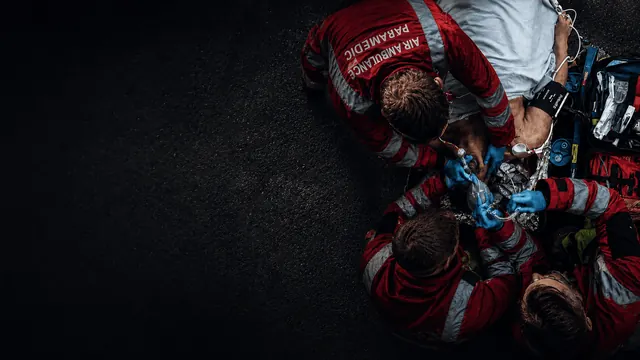
A department can have everything required for intubation and still leave the team searching when it matters. Someone has to find the equipment, arrange a working surface, prepare the medication and check what is missing. If that work starts only when the decision to intubate is made, it competes with assessing the patient and agreeing the plan. When teams repeatedly have to assemble what should already be organised, they are compensating for the system.
SCRAM™ stands for Structured CRitical Airway Management. The principle is to have equipment and drugs organised before the team needs to reach for them, including when a patient arrives unexpectedly. Resus SCRAM™ organises airway equipment; CRASH Rx organises emergency anaesthesia drugs. Stocked and checked between uses, the bags are ready to be taken to the bedside and opened into a structured layout, carrying that preparation straight into the team’s hands.
Resus SCRAM™
An airway preparation layout for hospital practice.
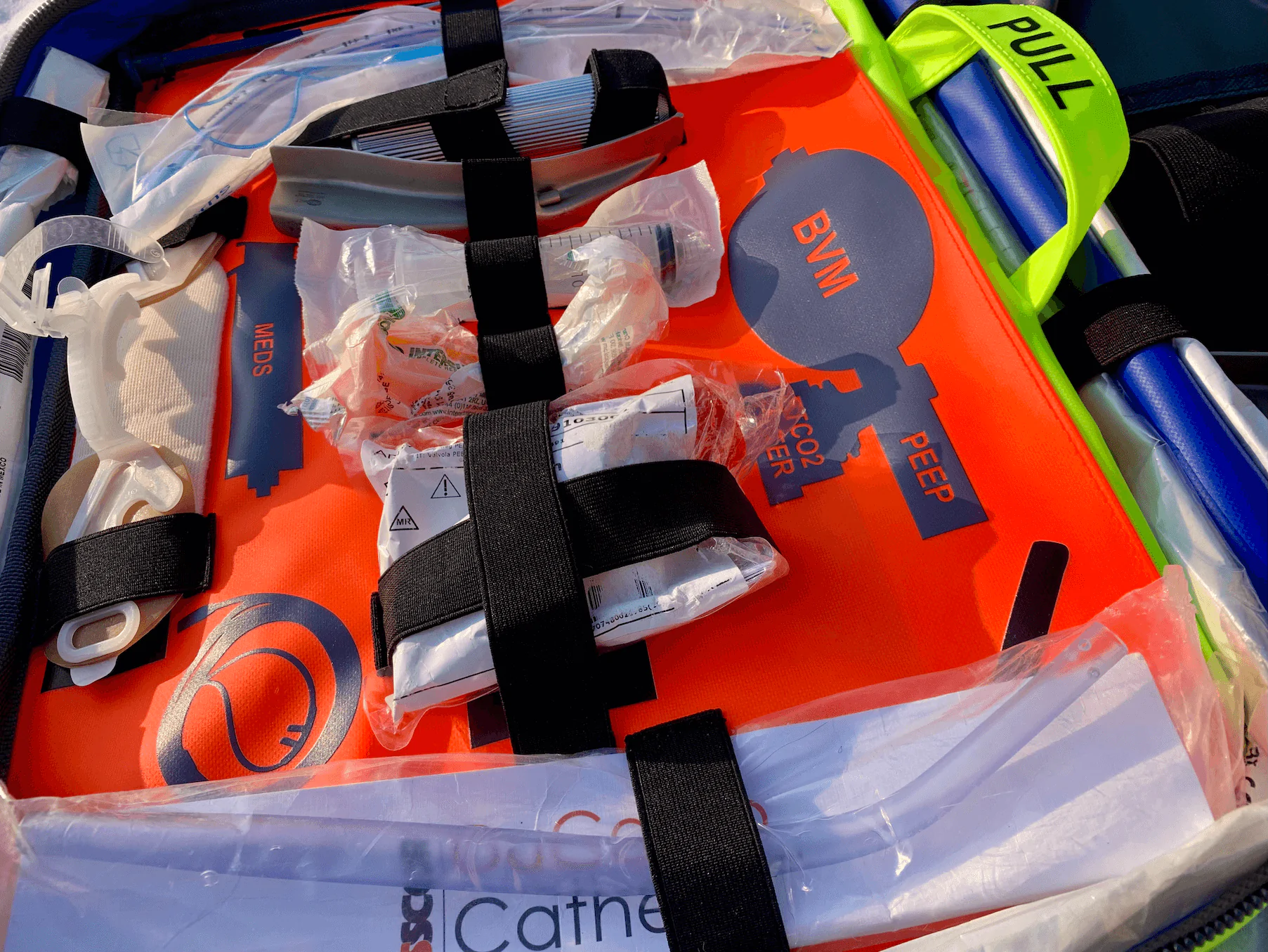
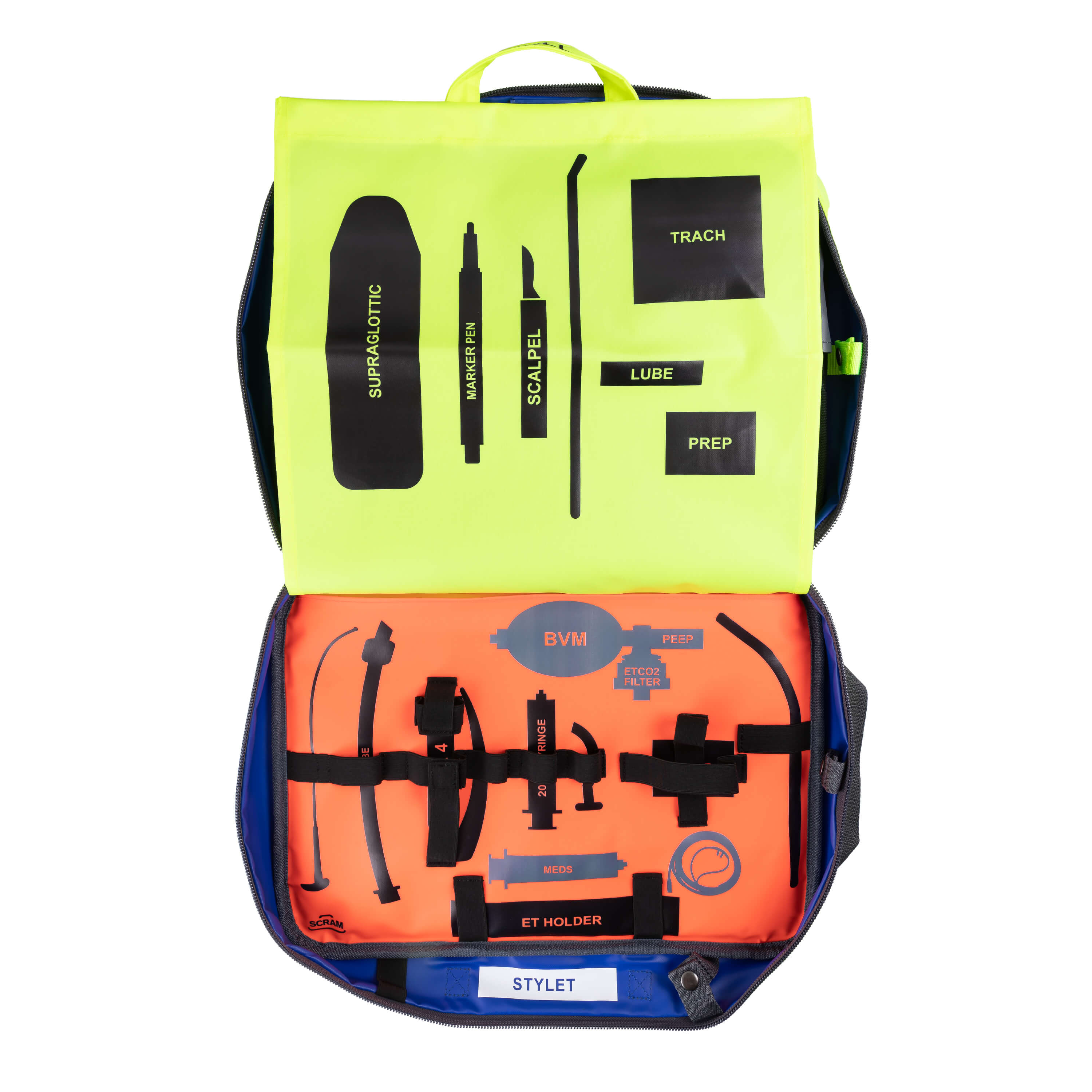
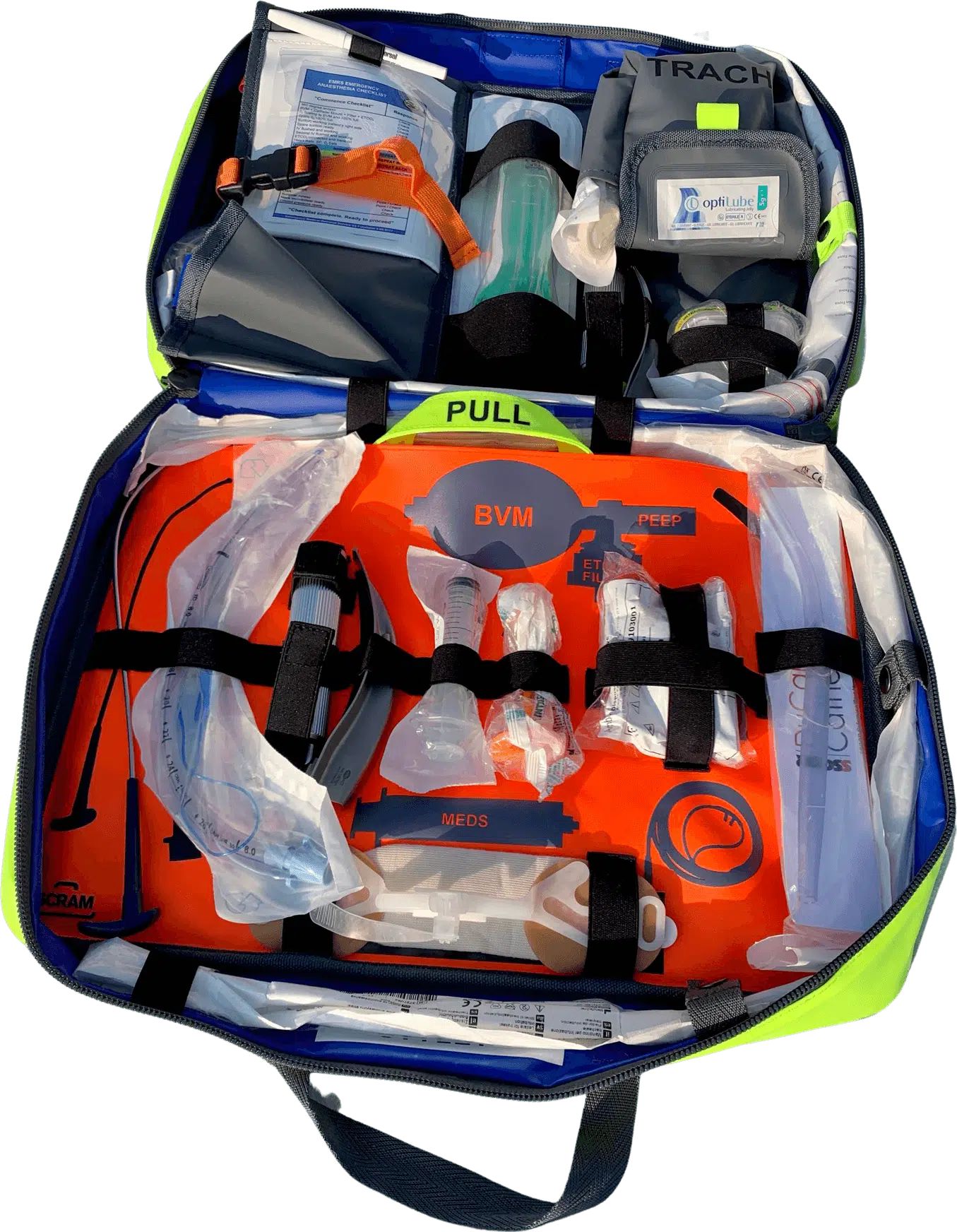
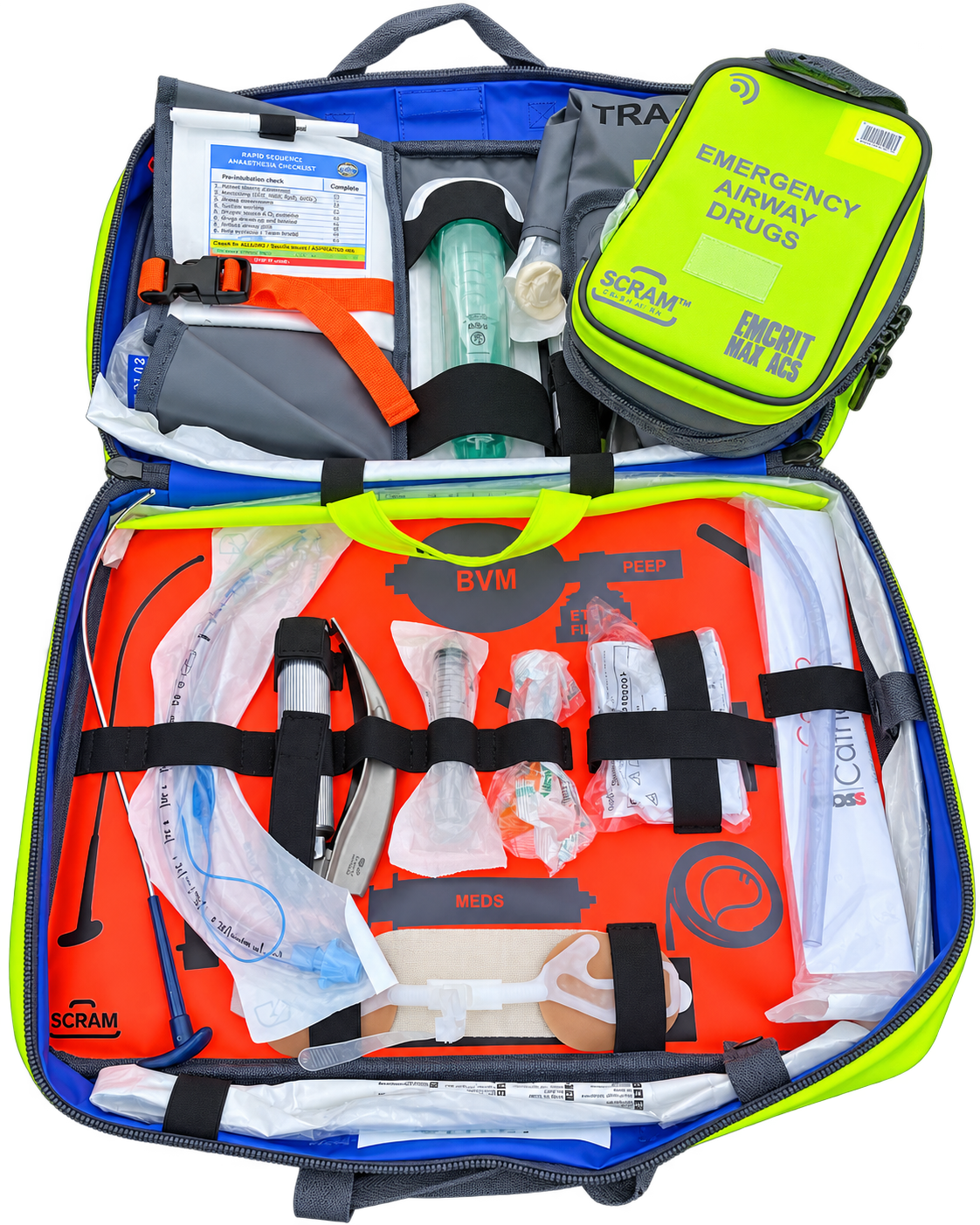
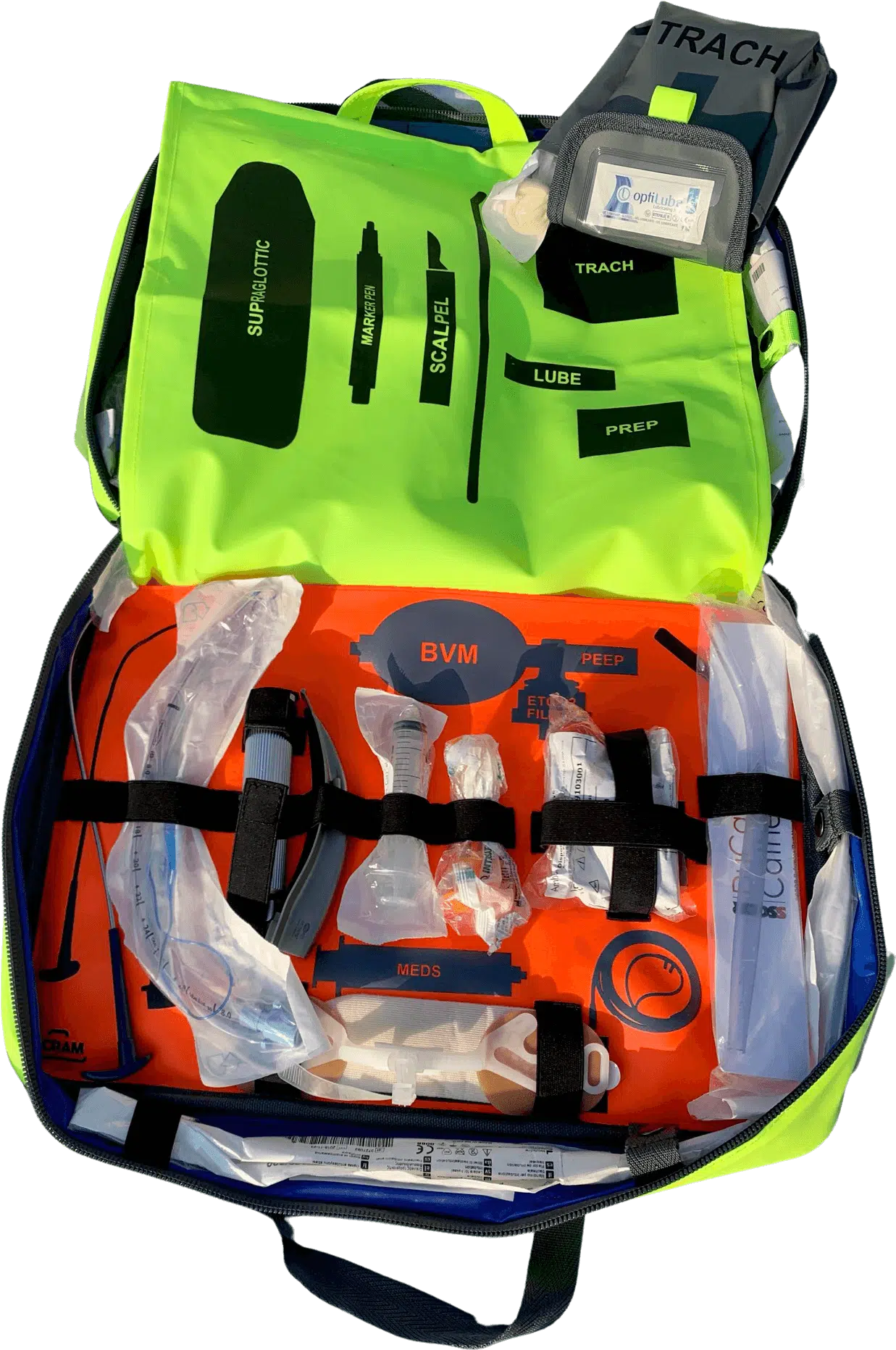
Resus SCRAM™ is an emergency airway bag designed for services that use video laryngoscopy as their primary modality. It opens into a stencilled kit dump, with marked positions for equipment to be laid out and checked.
In his demonstration, Scott explains the distinction between items stocked inside the bag and marked spaces for equipment brought from elsewhere. The video-laryngoscopy cart remains a separate part of the setup.
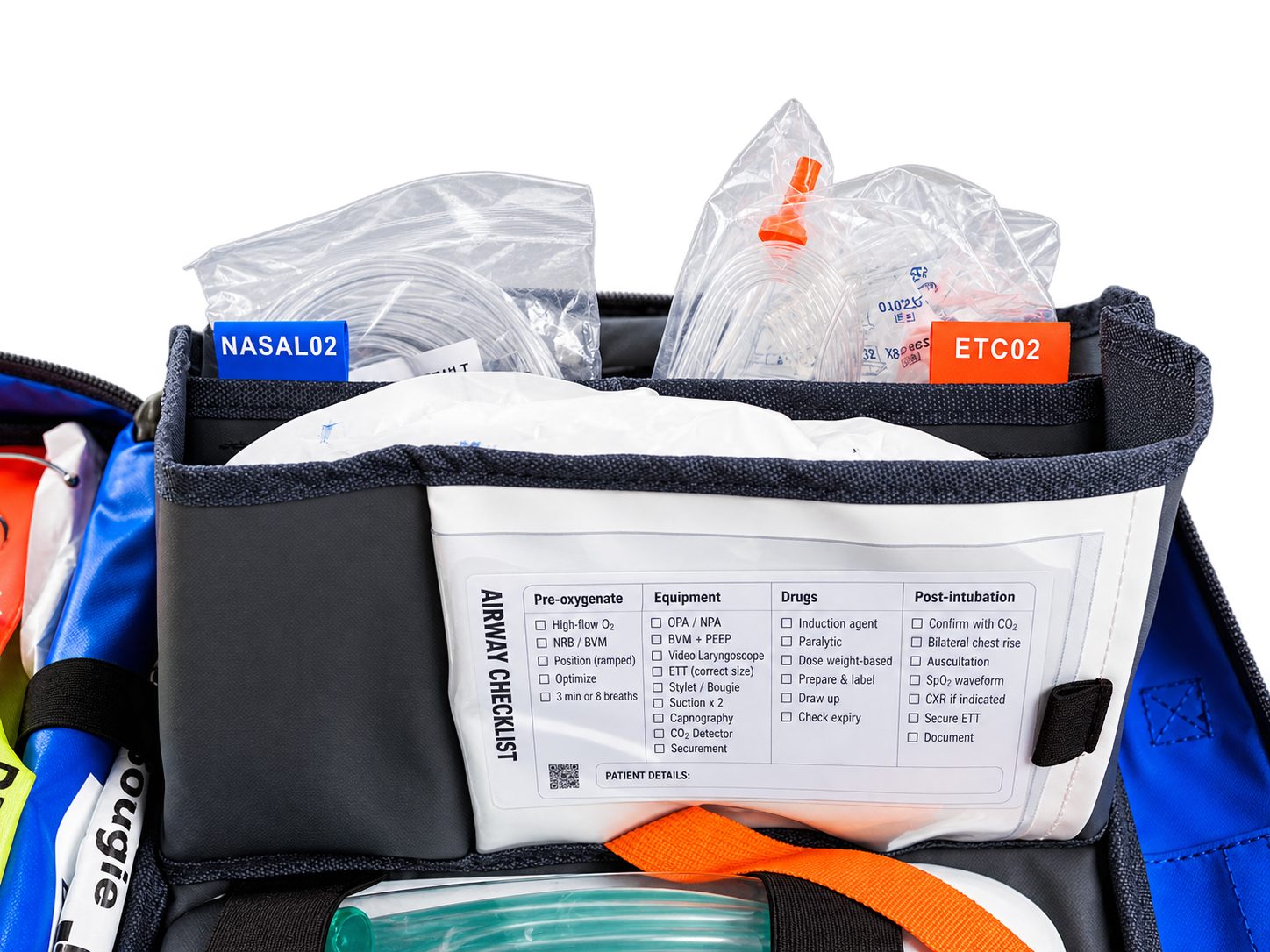
A removable difficult-airway kit dump and separate cricothyrotomy pouch (the Trach pouch) provide a preparation area for rescue equipment. The team can organise that equipment alongside the primary plan.
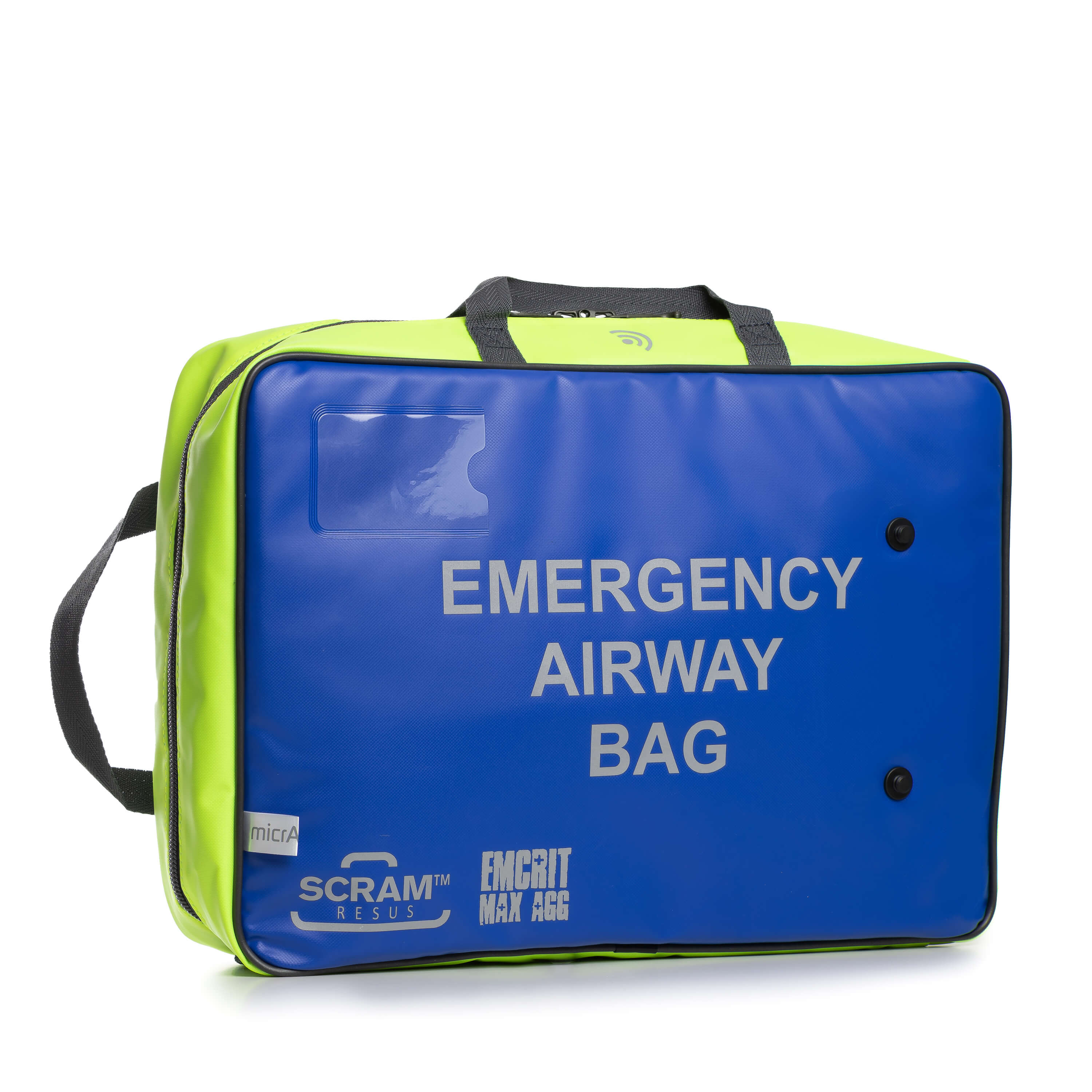
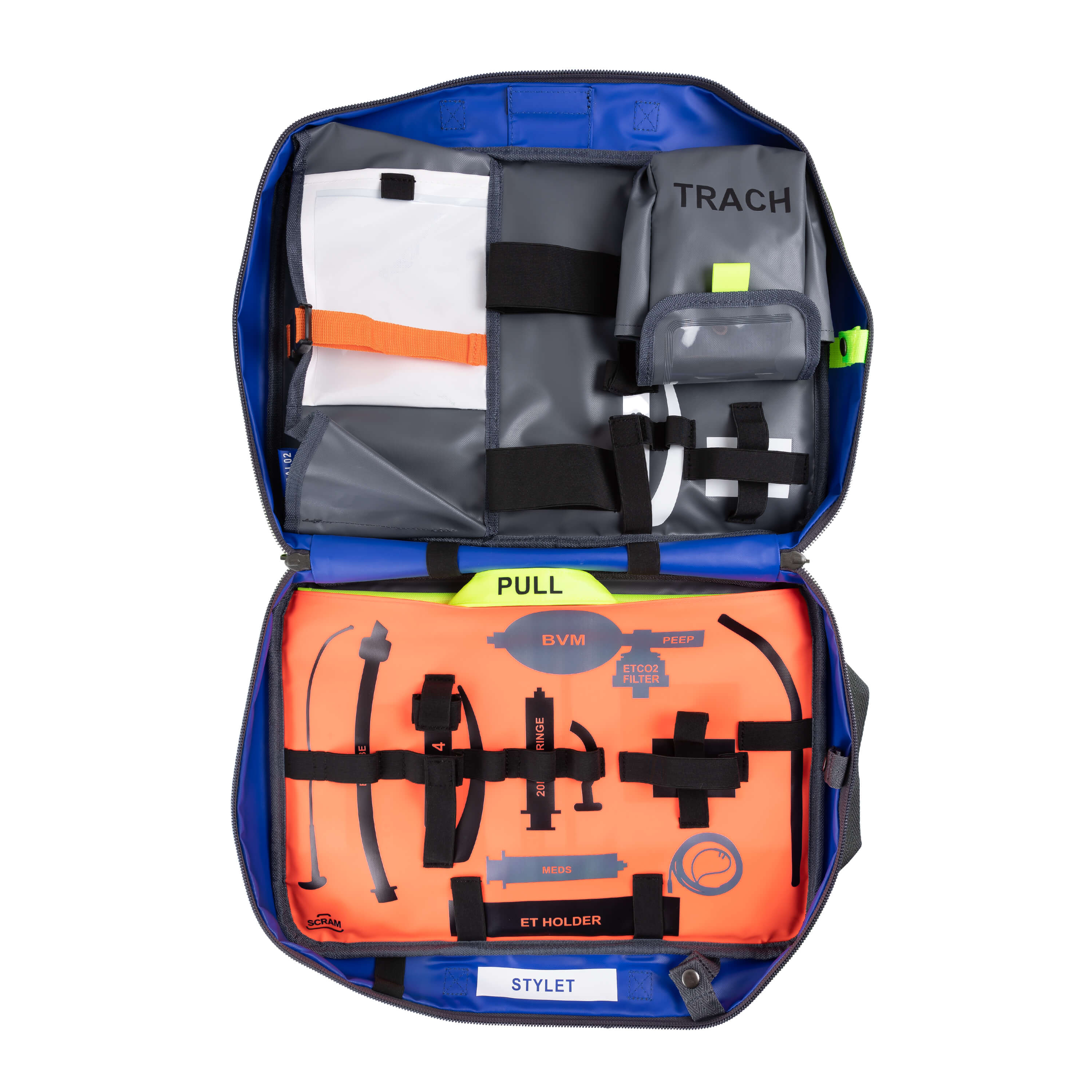
1 / 7 · Resus SCRAM™ closed bag
- Stencilled positions for stocking and checking equipment.
- A removable difficult-airway panel and separate cricothyrotomy pouch.
- Bougie storage and identifiable access points.
CRASH Rx SCRAM™
A defined place for emergency-anaesthesia medication.
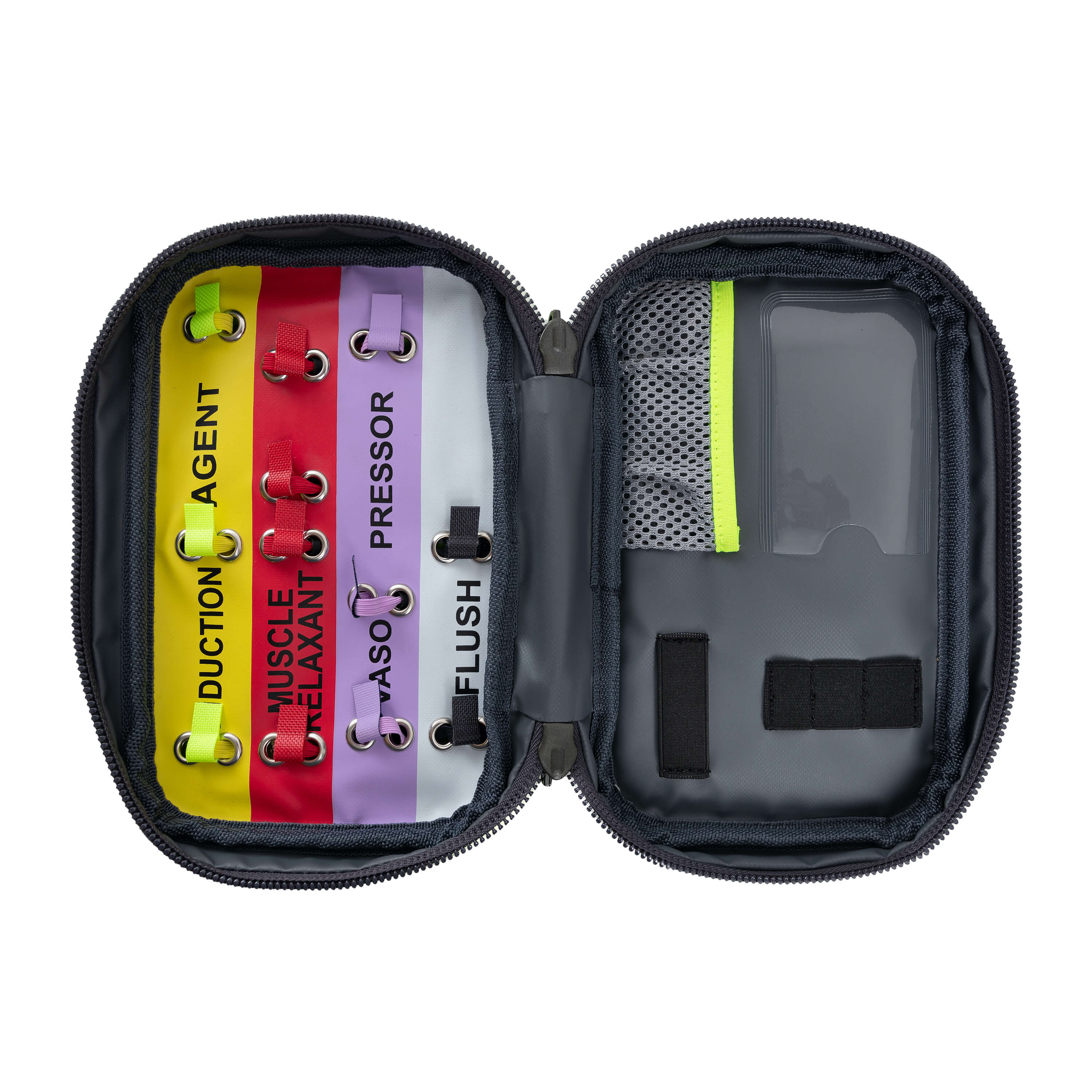
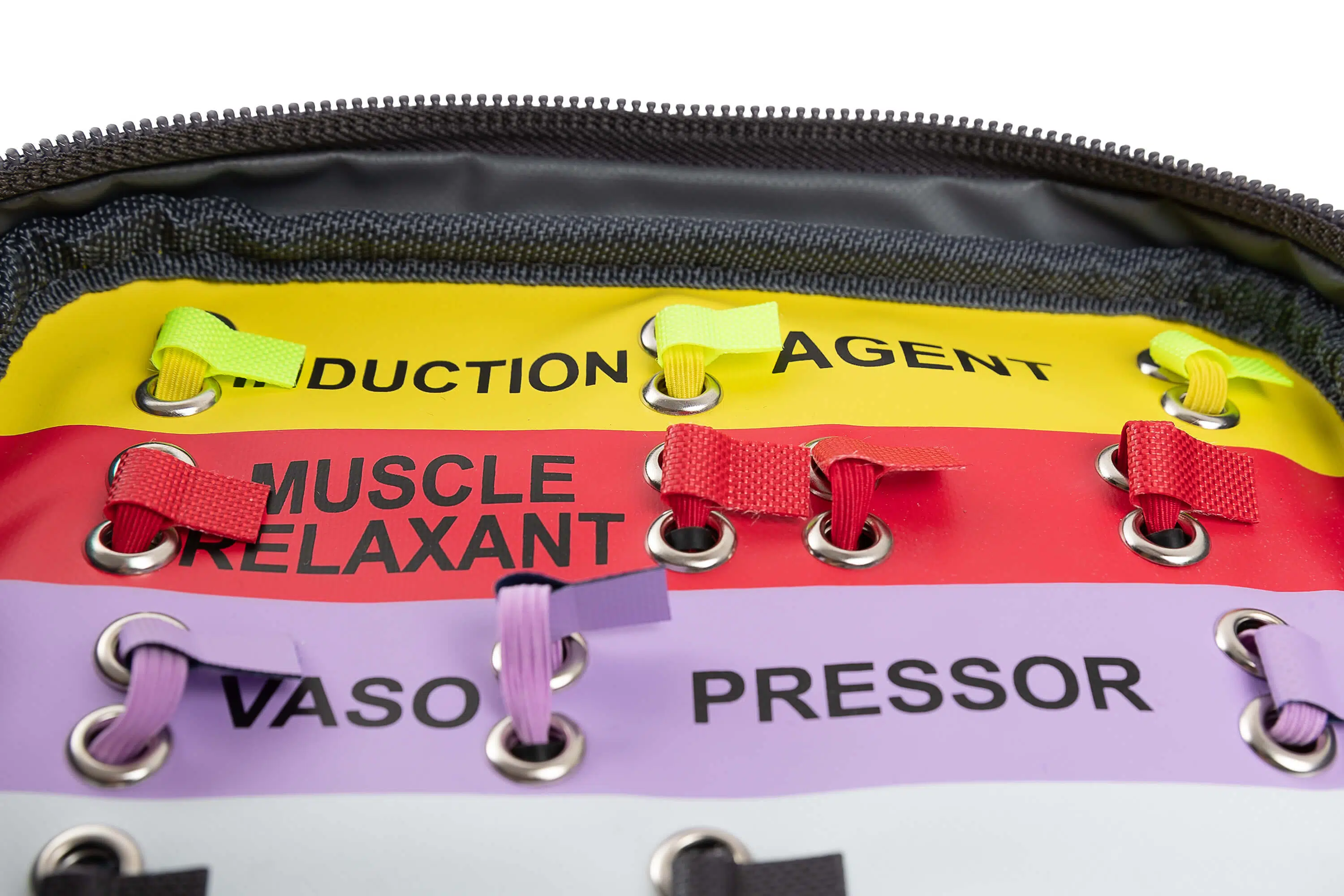
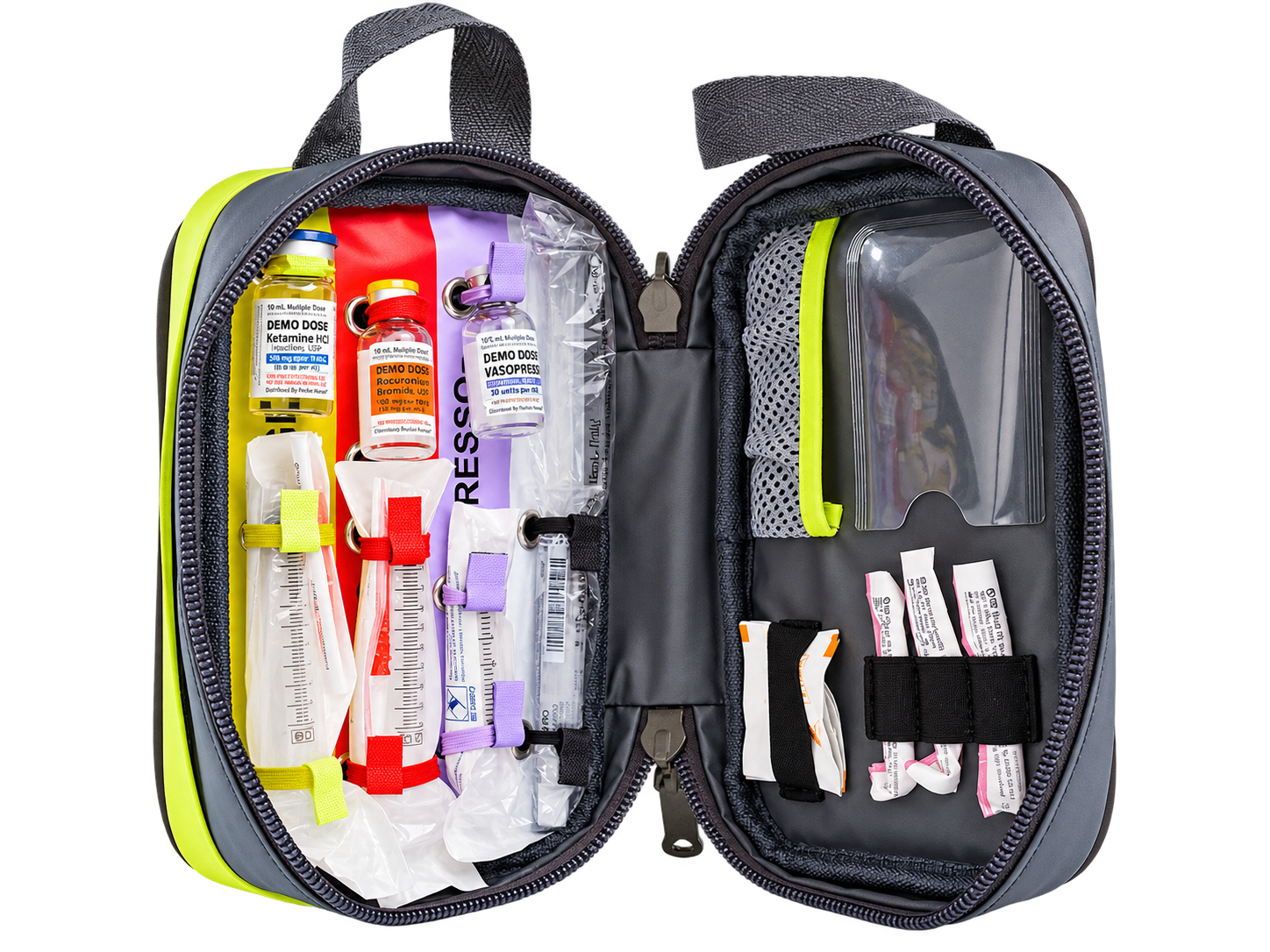
CRASH Rx is the compact version of the Rx SCRAM™ line. It organises emergency-anaesthesia medication by drug class, with labelled, colour-coded sections and space for the associated preparation items.
Scott describes its purpose as a compact medication set for an unexpected intubation. Adjustable retention allows the layout to accommodate different vial and syringe sizes.
It can hold pre-filled syringes, ampoules, vials or a combination. Medication selection, preparation, labelling, storage and expiry arrangements remain part of the service’s medicines governance.
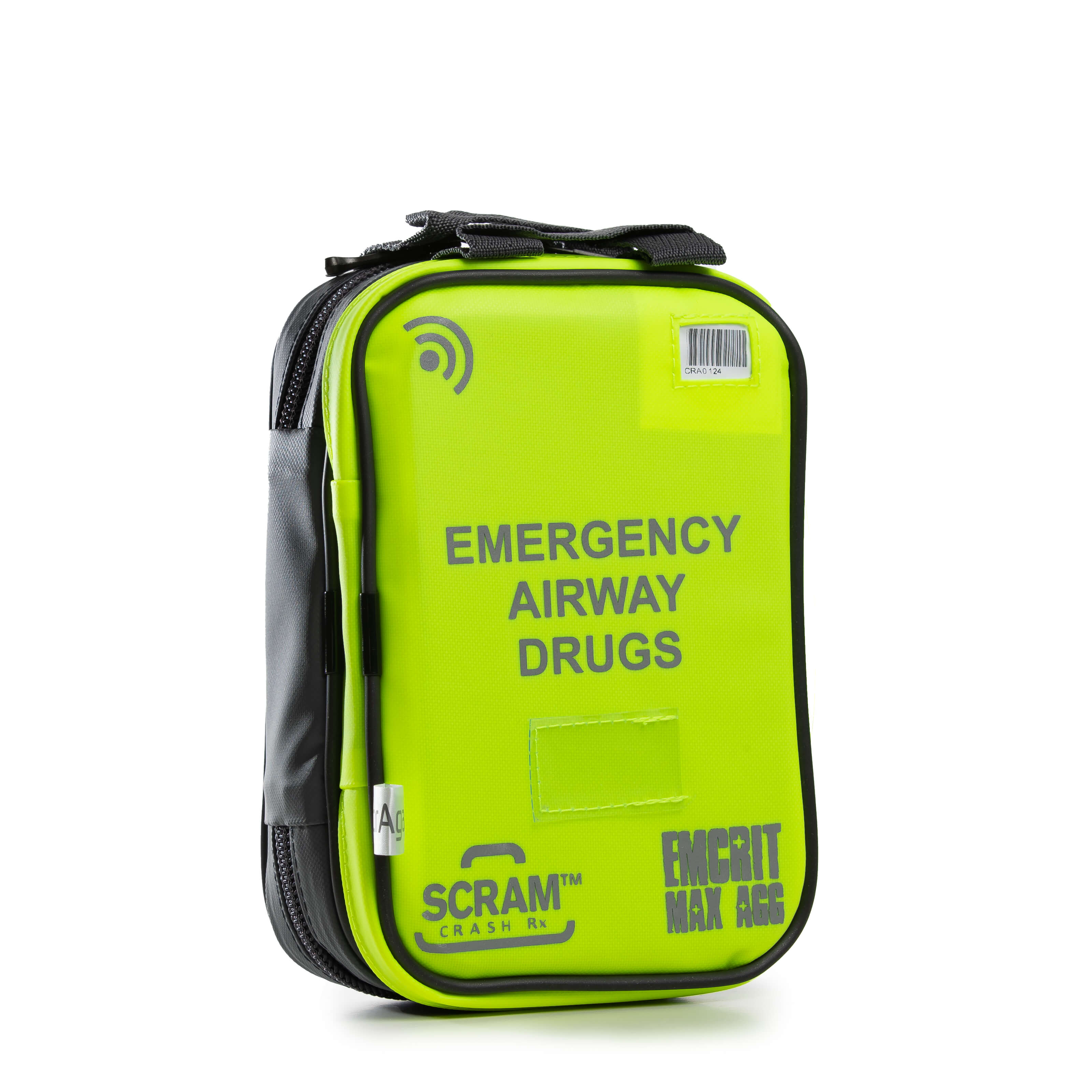
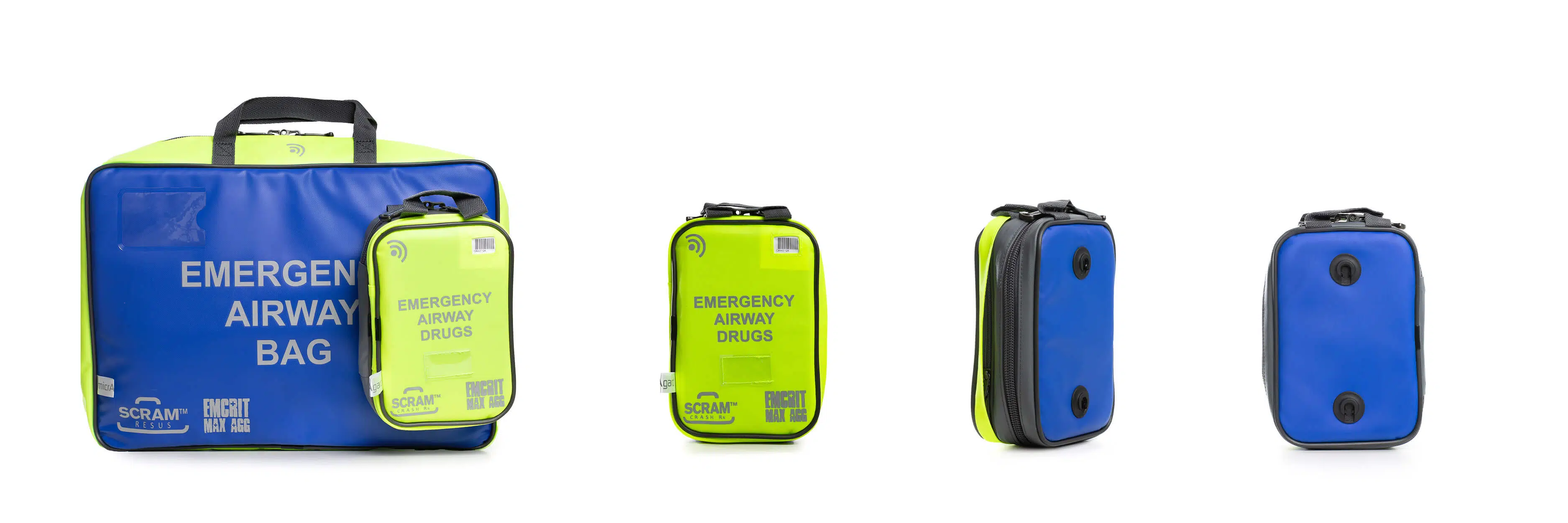
1 / 4 · CRASH Rx closed bag
- Separate labelled areas for induction agent, muscle relaxant, vasopressor and flush.
- Adjustable retention for the service’s chosen medication packaging.
- Fidlock attachment to Resus SCRAM™.
The design
Three decisions that shape preparation.
A layout the team can check
Stencilled positions provide a reference for stocking and preparation. The same arrangement helps the person preparing the bag and the person checking it identify what belongs where.
Rescue preparation has its own space
The removable difficult-airway panel keeps rescue equipment in its own working area, alongside the equipment for the initial plan.
Equipment and medication connect
CRASH Rx attaches to the front of Resus SCRAM™ through the Fidlock system. The two components travel together while retaining separate layouts for equipment and medication.
Features
The details that support everyday use.
Practical detail
Ready for the next use.
The practical details matter between procedures as well as during them: identifying the bag, checking stock and expiry dates, securing its contents and cleaning it after use.
Product photographs show example configurations. Equipment and medicines shown should not be assumed to be included in the purchase.
Resus: equipment layout
Stencilled kit dump, dedicated bougie storage and a secondary removable difficult-airway kit dump with a removable cricothyrotomy (Trach) pouch.
Resus: access and attachment
Gross-motor indicators identify access points. Front Fidlock fittings connect compatible CRASH Rx or Rx components; confirm the intended combination with the supplier. Watch the Fidlock attachment ↗
CRASH Rx: medication organisation
Drug-class sections are labelled and colour-coded to reflect established anaesthetic syringe-labelling conventions. They accommodate pre-filled syringes, ampoules, vials or a mixture. Retention can be adjusted for different vial and syringe sizes. The bag also has a secondary access section.
CRASH Rx: expiry and connection
A visible expiry-date window supports the local checking process. Rear Fidlock fittings attach the medication bag to Resus SCRAM™.
Identification and audit
Barcode identification, a checklist pocket and an RFID / NFC pocket support local equipment identification and audit routines. The RFID / NFC tag is not included.
Tamper-evident arrangements
Lockable zips are compatible with tamper-evident seals. Stocking, sealing and checking remain defined local responsibilities.
Materials and cleaning
Both products use wipe-clean micrAgard™ material and are described as weatherproof by the manufacturer. Follow the applicable cleaning instructions and local infection-control procedures.
Designed for pressure
Readiness includes what happens after use.
After an intubation, replenishing Resus SCRAM™ restores the equipment to its stencilled positions, ready for the next case. Restocking CRASH Rx restores the medication supplies within their designated sections. This moves the work of finding and organising those items into the time between procedures.
Whether the next patient arrives unexpectedly or following a pre-alert, the team can open the bags beside them and work from the prepared layouts. The preparation completed after one case becomes the starting point for the next.

Orders and enquiries
Where to order.

Product specifications, configuration and global orders.
Order Resus SCRAM™ ↗Order CRASH Rx ↗
A US ordering route for both products.
Order Resus SCRAM™ ↗Order CRASH Rx ↗Resus SCRAM™ and CRASH Rx were developed by Paul Swinton and Professor Scott Weingart. The original SCRAM™ system was co-invented by Paul Swinton and Neil Sinclair. Openhouse Products manufactures and distributes the products, with The Resus Tailor providing a US ordering route.
Disclosure. I developed Resus SCRAM™ and CRASH Rx with Professor Scott Weingart and have a commercial interest in SCRAM™. Openhouse Products manufactures and distributes the products; The Resus Tailor is a US distributor.
The wider SCRAM™ story. Read about the preparation problem, design principles and research behind the original system.
Read the SCRAM™ story →Explore the SCRAM range
Explore the SCRAM™ range.
Equipment, medication and procedural preparation for different clinical settings.
Designed for the realities of emergency airway management.
Resus SCRAM™ and CRASH Rx give airway equipment and medication preparation a defined place within the hospital setup.