

Structured airway preparation
Paediatric SCRAM™ Line
Emergency paediatric airway equipment. Pre-prepared and ready at a moment’s notice. From neonates to adolescents.
Explore the two bags
Two options. Built for different settings.
Compare Paediatric SCRAM™ for hospital and retrieval with the compact PaedEMS SCRAM™ for prehospital care.
Hospital / retrieval
Paediatric SCRAM™
Inside the bag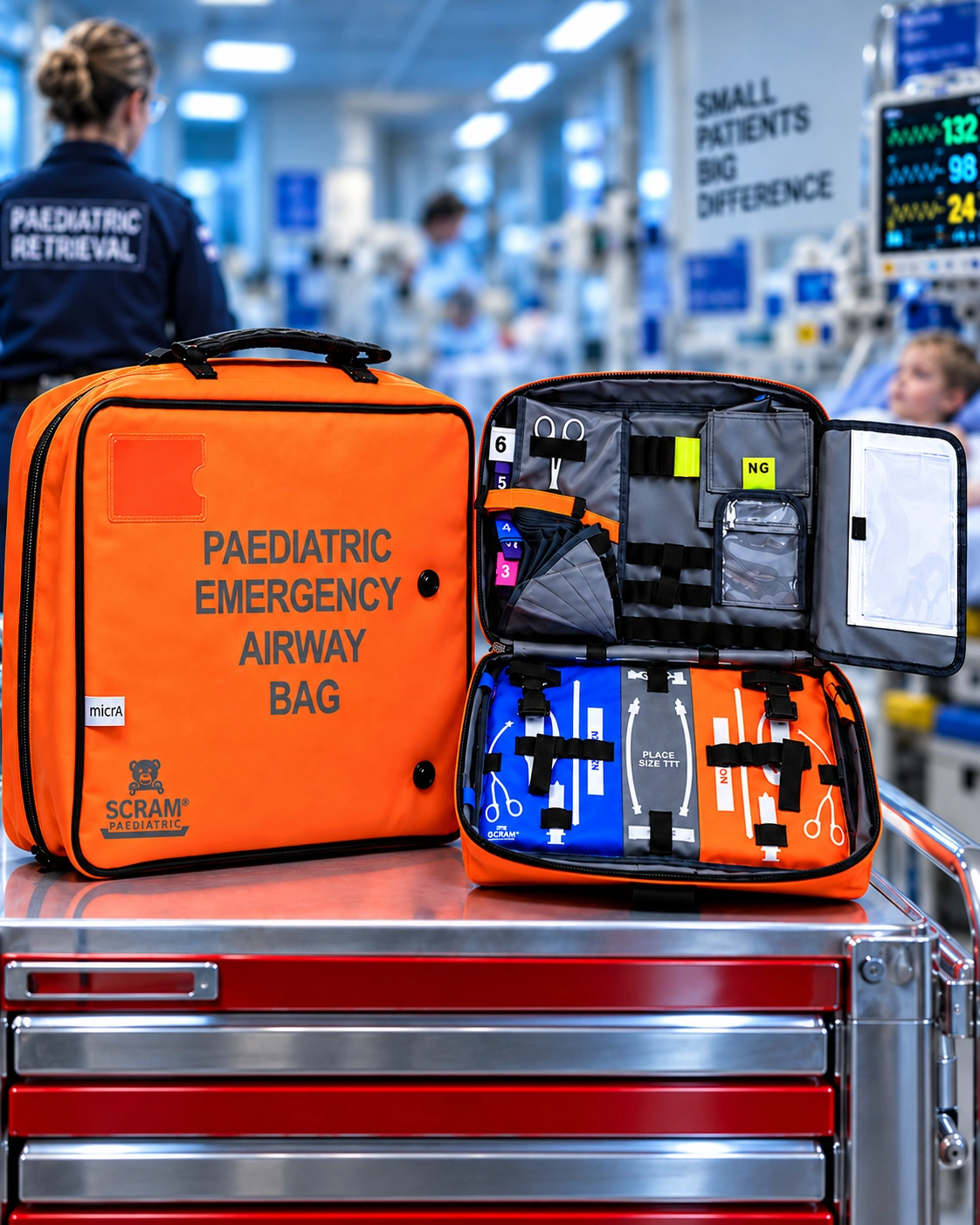
Adult SCRAM™ principles adapted to paediatric airway management. A structured layout designed to reduce preparation time, error and cognitive load.
Prehospital / EMS
PaedEMS SCRAM™
Inside the bag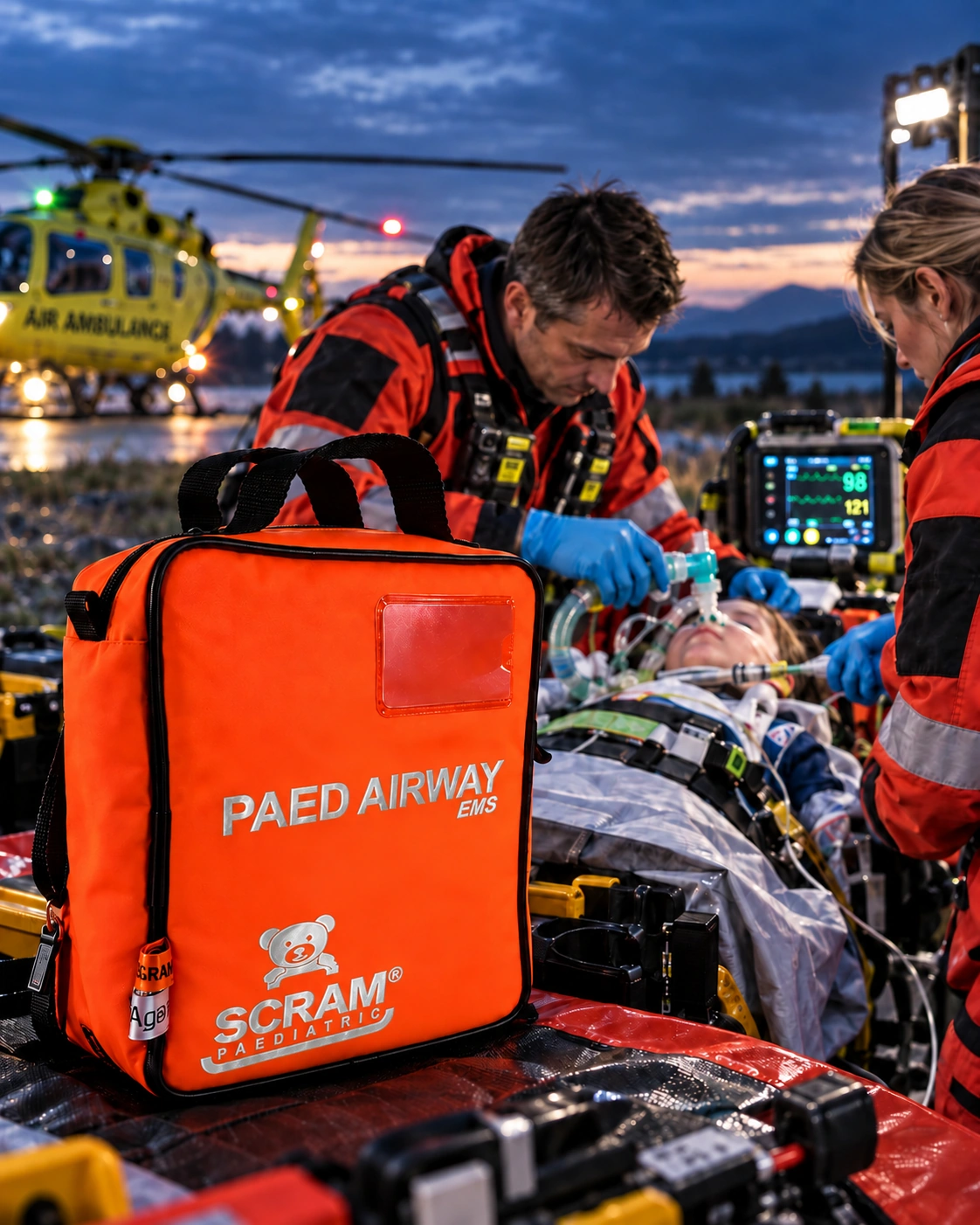
A compact system designed around the realities of prehospital paediatric airway management — limited space, rapid access and equipment that needs to be immediately visible.
Same principles. Different settings.
Compare the two systems
Paediatric SCRAM™ / PaedEMS SCRAM™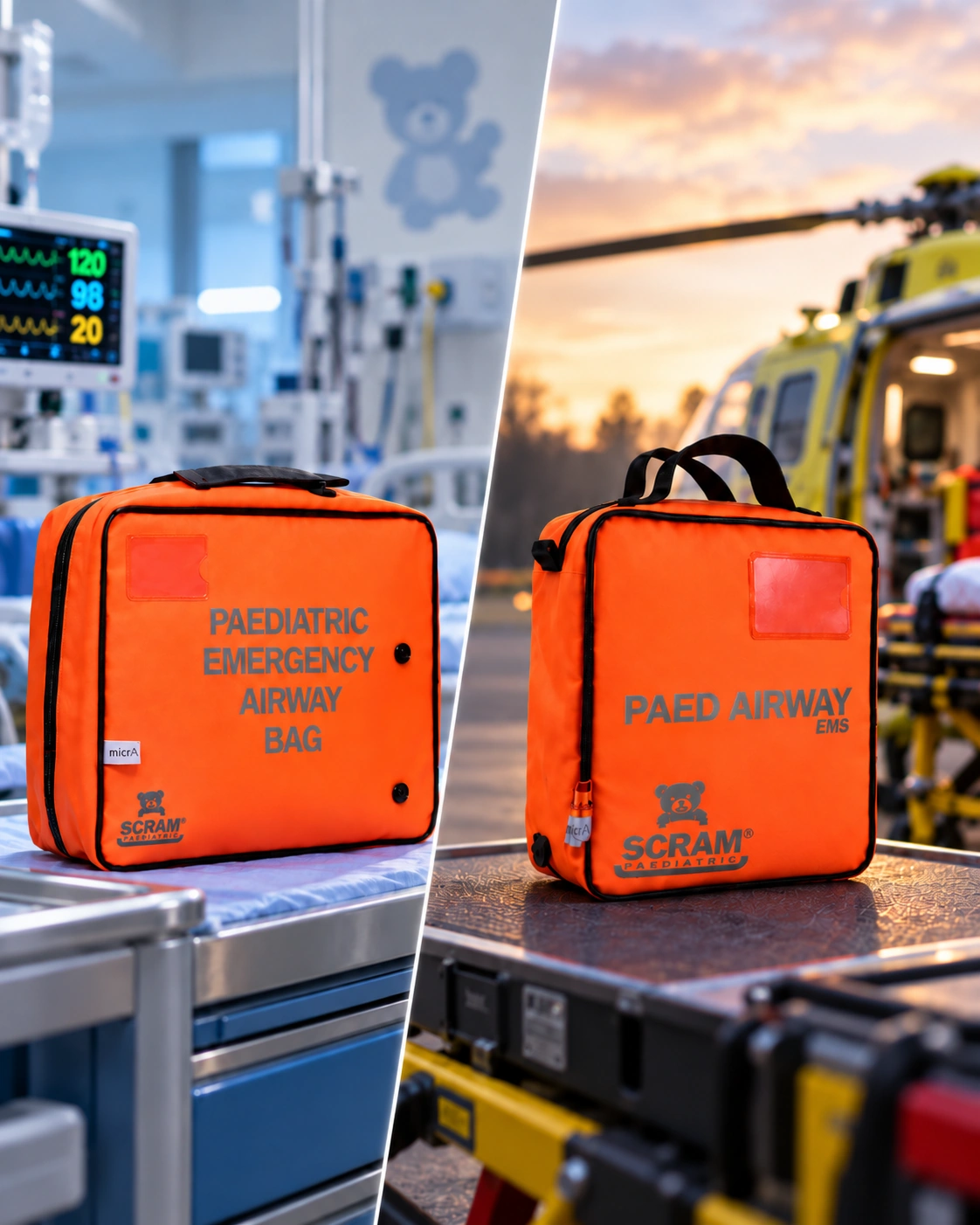
See how the same SCRAM™ principles are adapted through different layouts, equipment organisation and operational settings.
Bougie storage in the comparison film: larger and smaller bougies can be stored along the spine. The PaedEMS demonstration shows their working ends running parallel to the spine to keep that section straight. A separate holder is an option where straight storage is required. Watch this detail
Collaboration
The collaboration behind the paediatric line.
The paediatric SCRAM™ line was invented and designed by Paul Swinton, Dr Jon McCormack and Neil Sinclair, building on the original SCRAM™ principles.

Paul Swinton
Clinical Team Leader & Flight Paramedic
Co-inventor of SCRAM™.
Clinical performance through systems design and human factors.

Dr Jon McCormack
Consultant Paediatric Anaesthetist & ScotSTAR Critical Care / Trauma Team
Co-inventor of the Paediatric SCRAM™ line.

Neil Sinclair
Chief Paramedic Officer
Northern Ireland Ambulance Service.
Co-inventor of SCRAM™.
- Designed for
- Neonatal-to-adolescent equipment preparation
- Used in
- Hospital, retrieval and prehospital teams
- Core function
- Structured, reproducible preparation for paediatric airway management.
- Supply route
- Openhouse Products / The Resus Tailor
The clinical friction
A wide equipment range. An infrequent emergency.
Following the success of Adult SCRAM™, there was strong demand from the community for a paediatric version. This brought a different design challenge: accommodating the broader range of equipment needed for children, from neonates to adolescents, within an ergonomic layout that keeps equipment easy to identify, select and use.
That preparation needs to work at the roadside as well as in hospital. Prehospital teams work with the equipment they carry, often within limited space and with limited assistance. The paediatric equipment range must fit within a compact, organised system that can be taken to the patient.
In hospital, performing an emergency paediatric RSI outwith the operating theatre environment is an extremely rare event. This may be necessitated by the sudden arrival of a critically injured child in the ED resus room, a medical collapse on a ward, or acute, unexpected deterioration during diagnostic or therapeutic interventions.
At present, many of these areas have a standard “resus trolley”. However, there is recognition that many rotating junior medical staff, and nursing staff who rarely encounter this procedure, are unfamiliar with the equipment needed, the sequence of events and the need for a standardised approach.
Either Paediatric SCRAM™ or PaedEMS SCRAM™, selected to suit the setting and equipment requirements, would provide a structured and standardised equipment process. This would allow bandwidth offloading for staff already under considerable cognitive pressure.
- A wide range of equipment sizes. From neonates to adolescents, the team must identify and prepare equipment appropriate to the individual child.
- Pre-paration beyond theatre. At the roadside, in resus or on a ward, the team needs equipment at the patient’s side, within the space and resources available.
- Cognitive pressure. Remembering, finding and organising equipment competes with assessing the child and planning the intervention. A pre-prepared, standardised approach is designed to reduce time to intervention, error and cognitive load.
The two systems
SCRAM™ does not change what we do; it changes how we do it.
SCRAM™ introduces an ergonomic change to an established clinical process. It structures how equipment is organised, selected and prepared, while retaining the clinician’s responsibility for patient-specific decisions.
01 · Hospital / retrieval
Paediatric SCRAM™
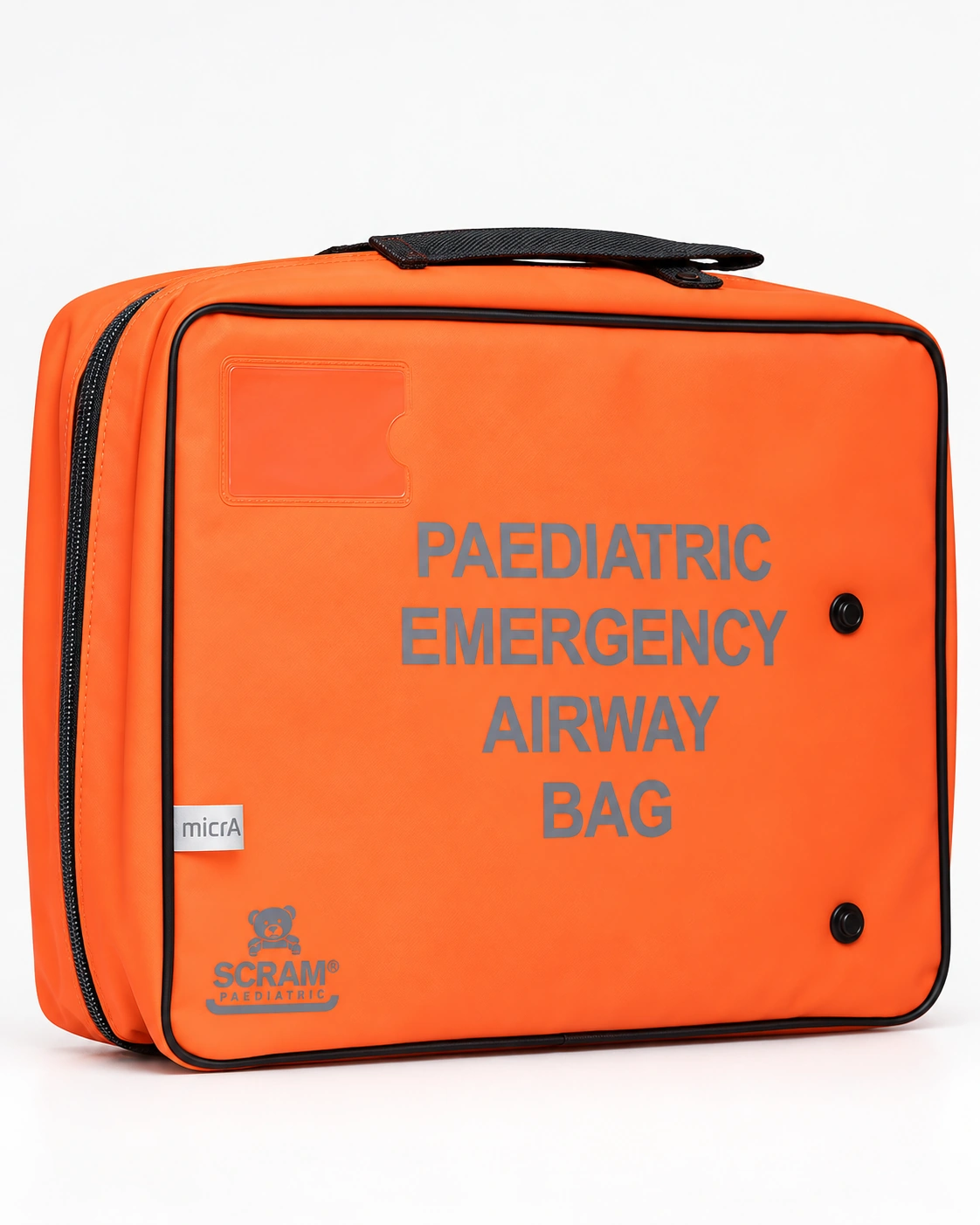
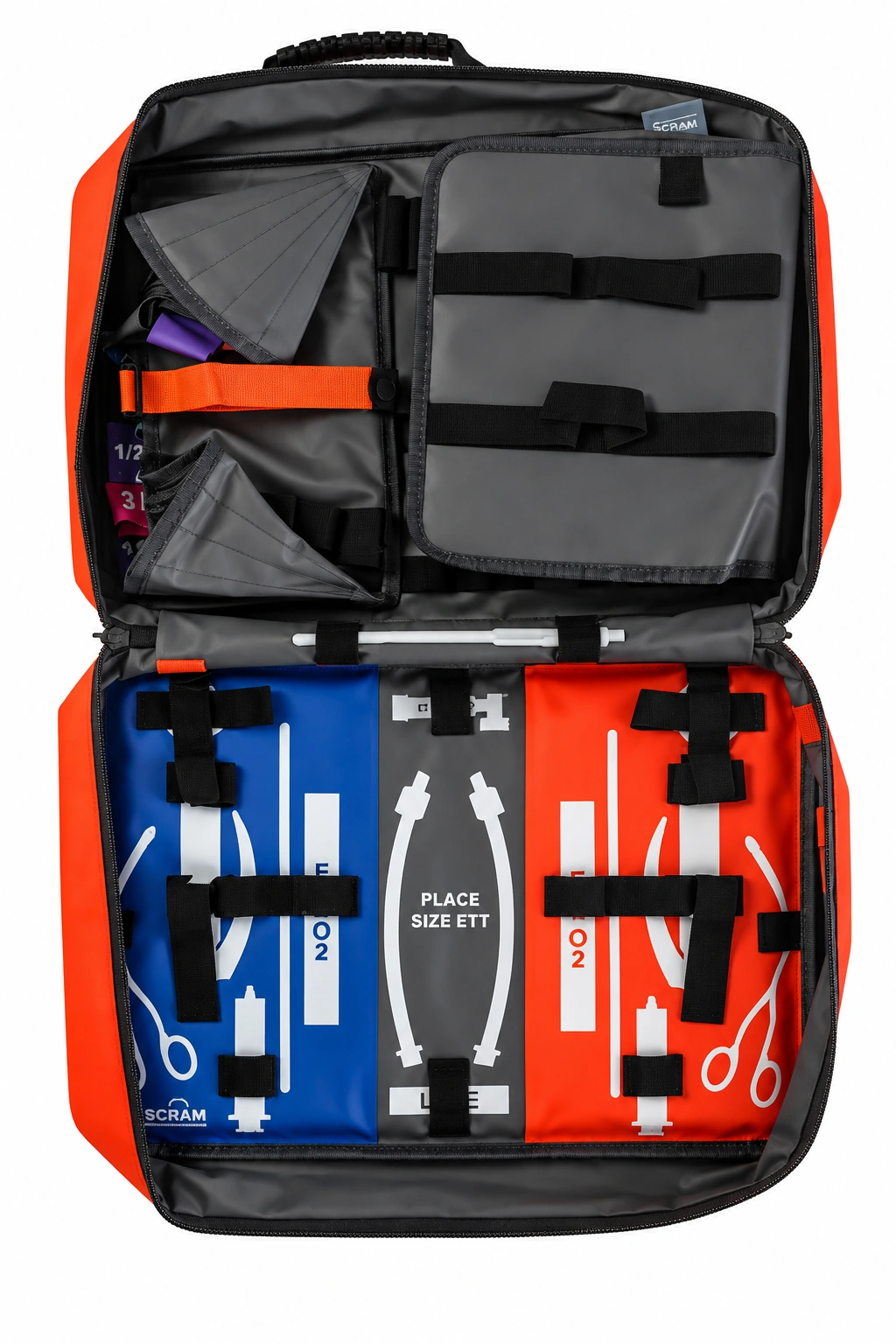
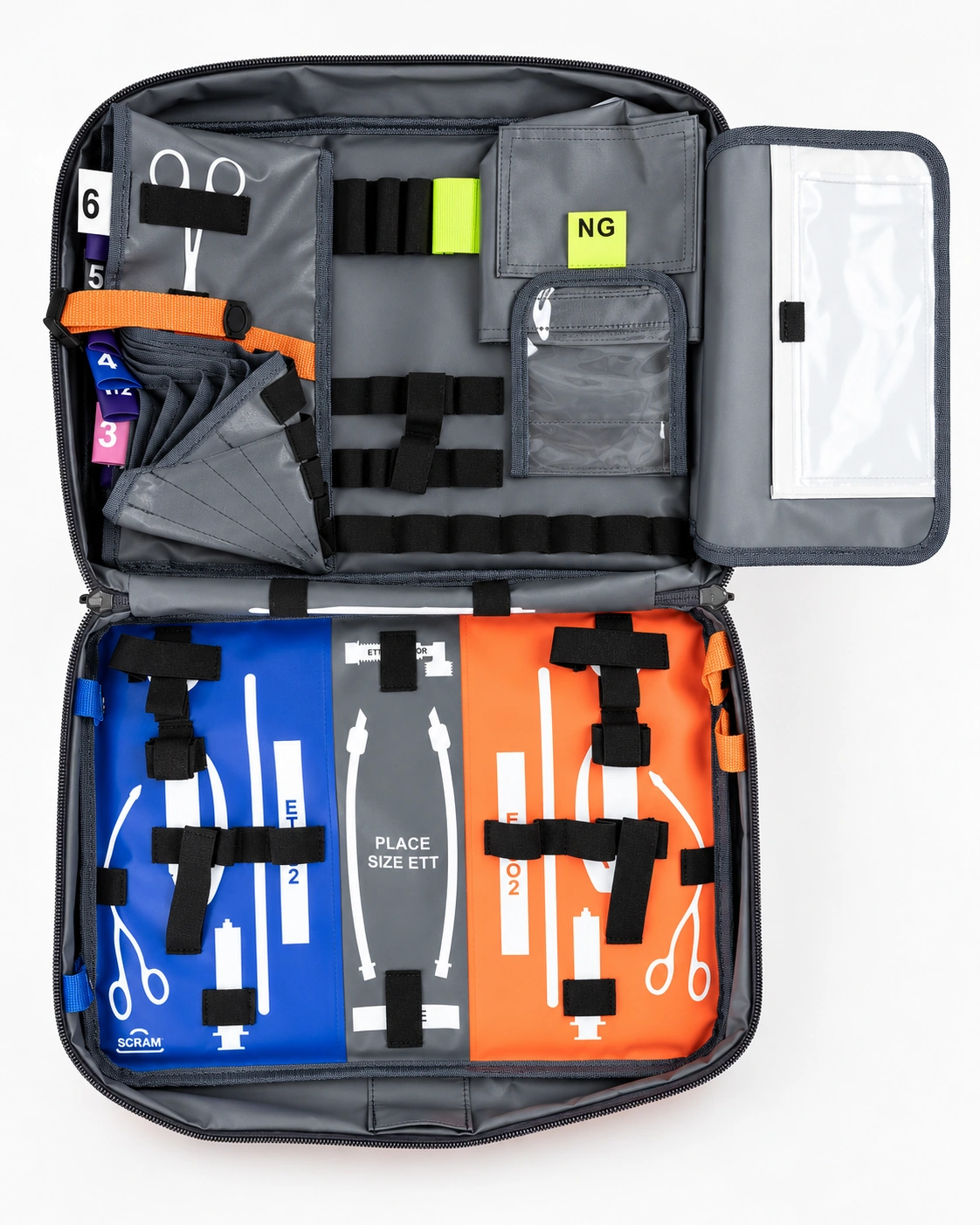
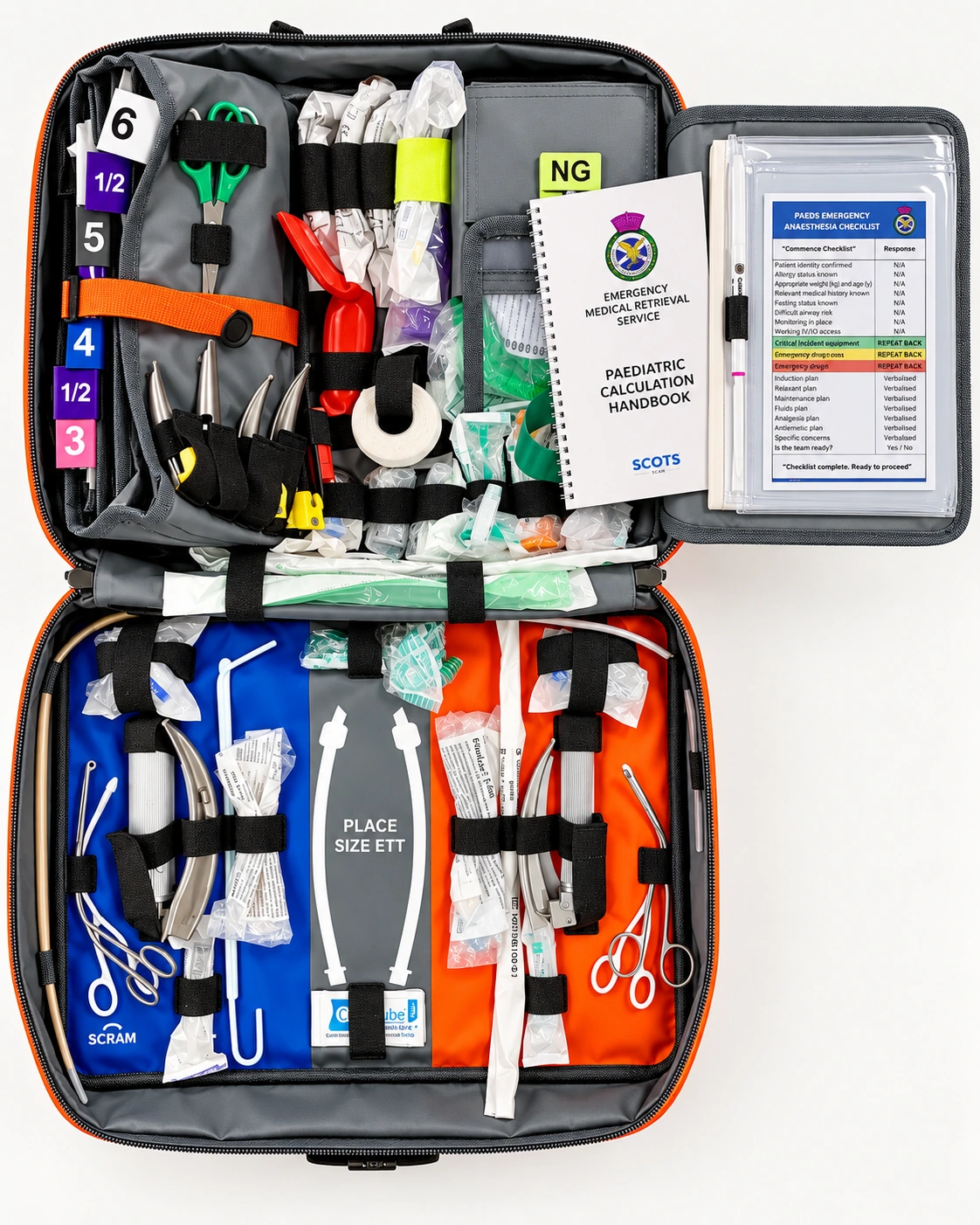
A paediatric emergency airway bag for hospital and retrieval teams, designed to carry a wider range of equipment than the compact PaedEMS SCRAM™. It opens to reveal a high-contrast, stencilled working area for two pre-prepared intubation setups, with additional airway equipment stored alongside.
- Dimensions
- 34 × 48 × 13 cm
- Carrying
- Grab handles, with an additional set on the current model.
- Physical features
- Elastic loops, an external window and reflective printing.
- Identification
- Barcode identification and an RFID/NFC pouch between the handles. Tag not included.
- Bag attachment
- Front Fidlock fittings for attaching a compatible Rx SCRAM™ bag. See how the attachment works ↗
Dimensions as listed by Openhouse Products. View current specification ↗
- Size-specific equipment, clearly separatedThe blue area holds equipment for larger children; the orange area holds equipment for smaller children. Each setup includes appropriately sized filters, end-tidal CO₂ components, bougies, stylets and suction equipment. Stencilled outlines show where each item belongs. The clinician selects the correct endotracheal tube for the individual child and places it in the marked central area.
- Additional airway equipment alongsideThe adjoining storage area holds basic airway adjuncts, suction catheters, endotracheal tubes and spare laryngoscope blades. A panel holds supraglottic airway devices, while masks are arranged so the available sizes can be seen. This keeps additional equipment accessible alongside the intubation working area.
- Checklists and cognitive aidsThe panel holding the supraglottic airways turns over to reveal a checklist pouch, wipe-clean writing surface and space for an Age per Page clinical support handbook. This keeps airway checklists and supporting information visible during preparation, with somewhere to record drug doses. The handbook is not included with the bag.
Size coverage: equipment for neonates through to adolescents, configured for the service’s intended patient range.
02 · EMS / PHEM / retrieval
PaedEMS SCRAM™
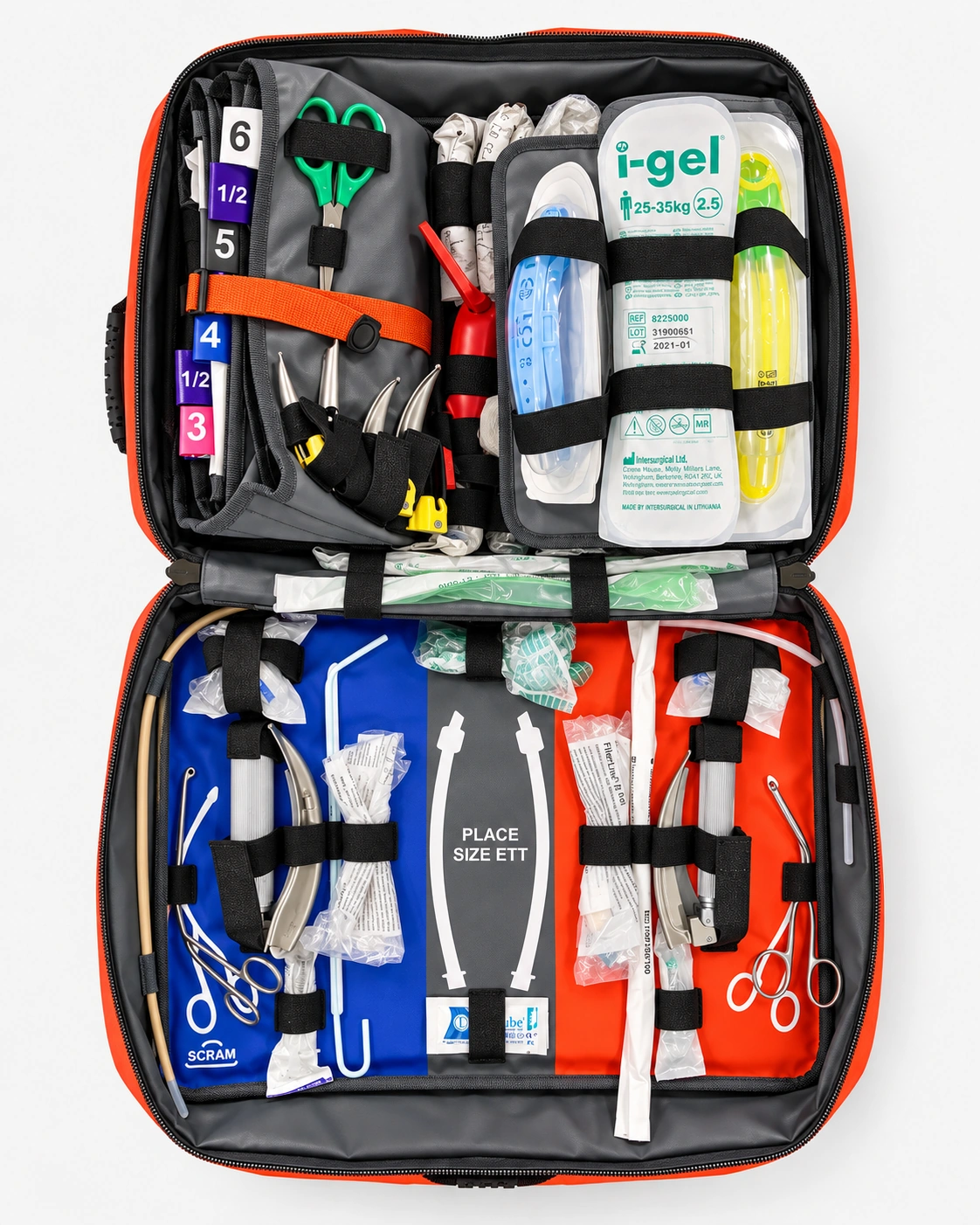
A compact paediatric emergency airway bag designed for EMS, prehospital emergency medicine (PHEM) and retrieval teams. The design rationalises a selection of equipment to cover the neonatal-to-adolescent age range, organised by age to make the appropriate equipment easy to identify and select. .
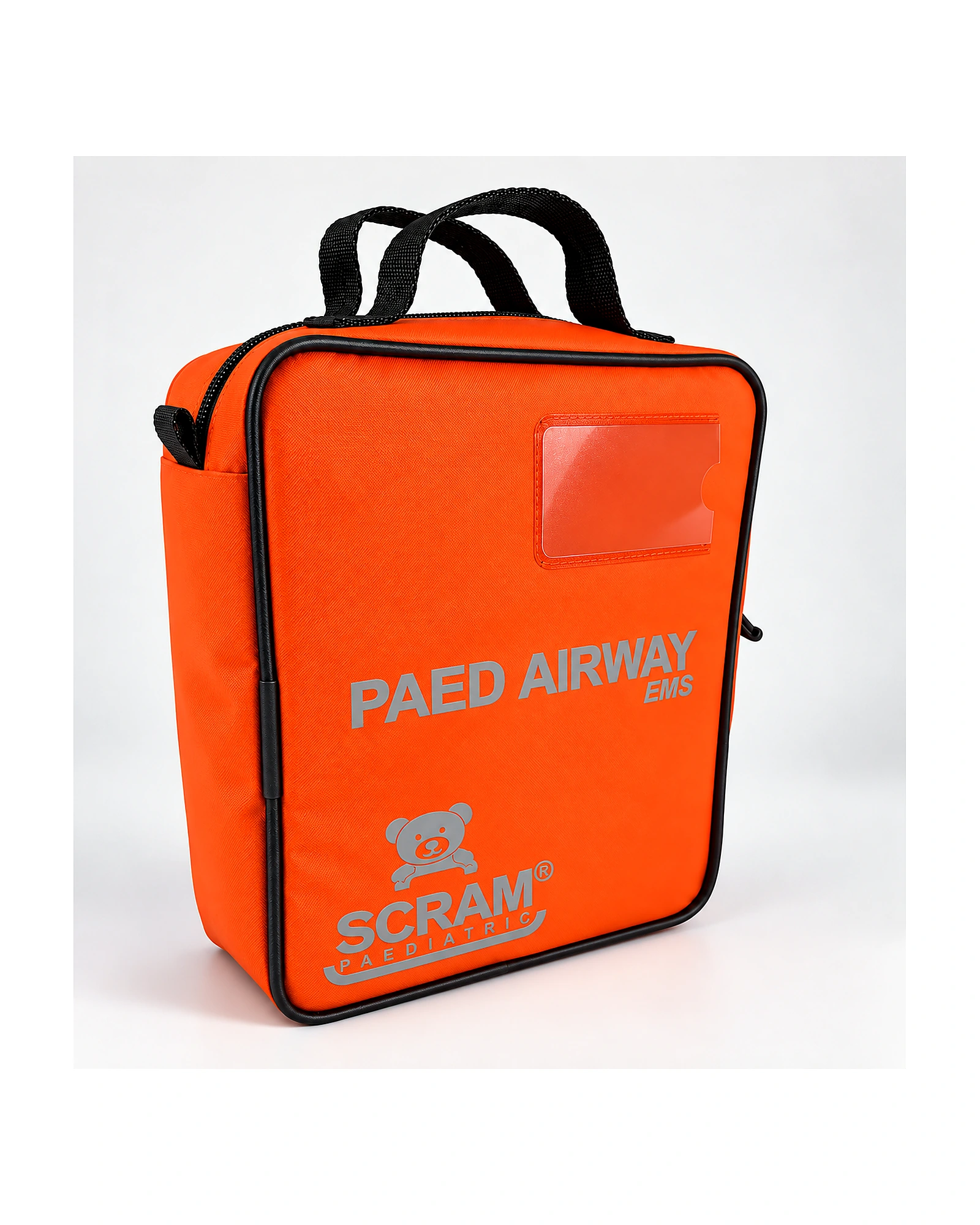
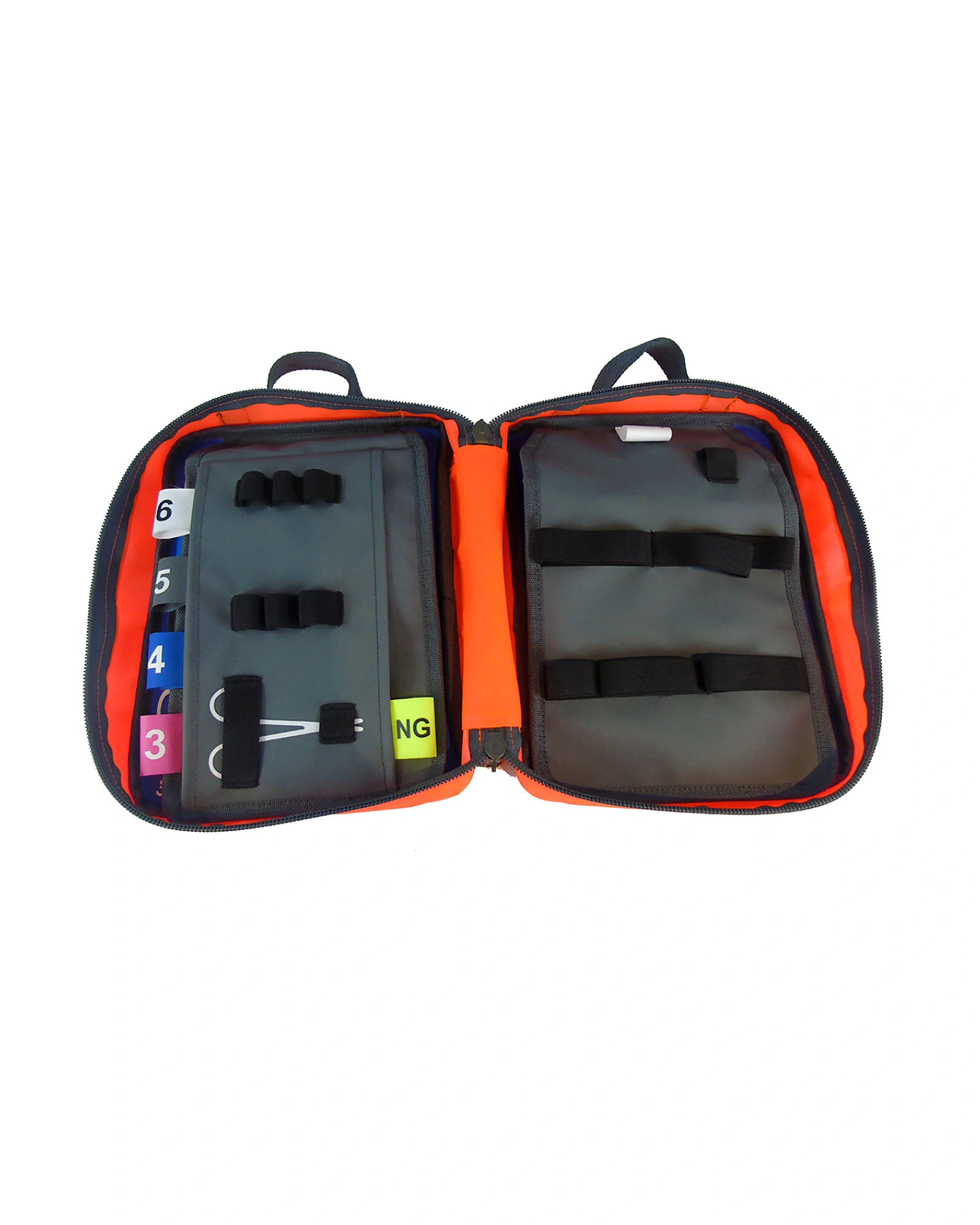
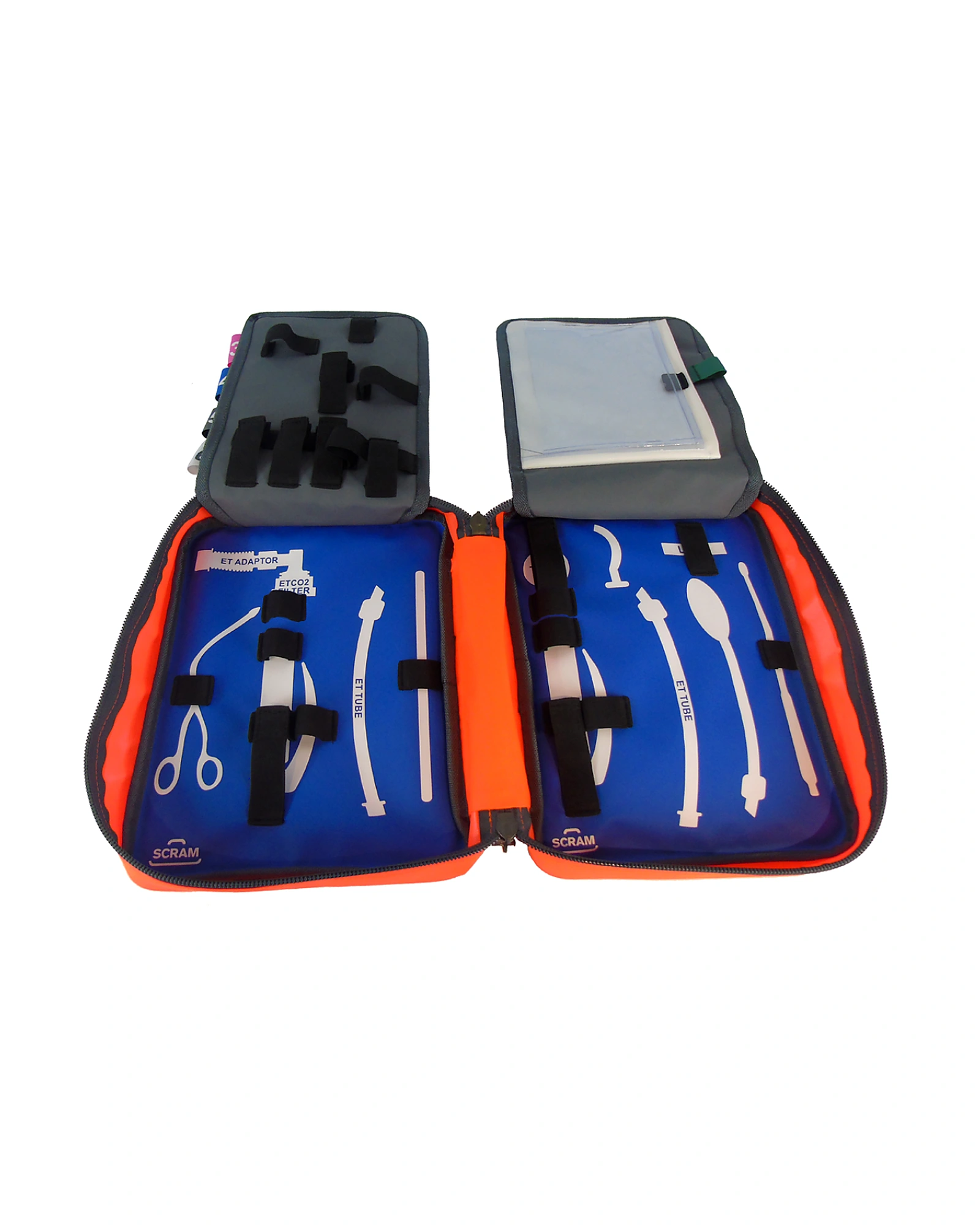
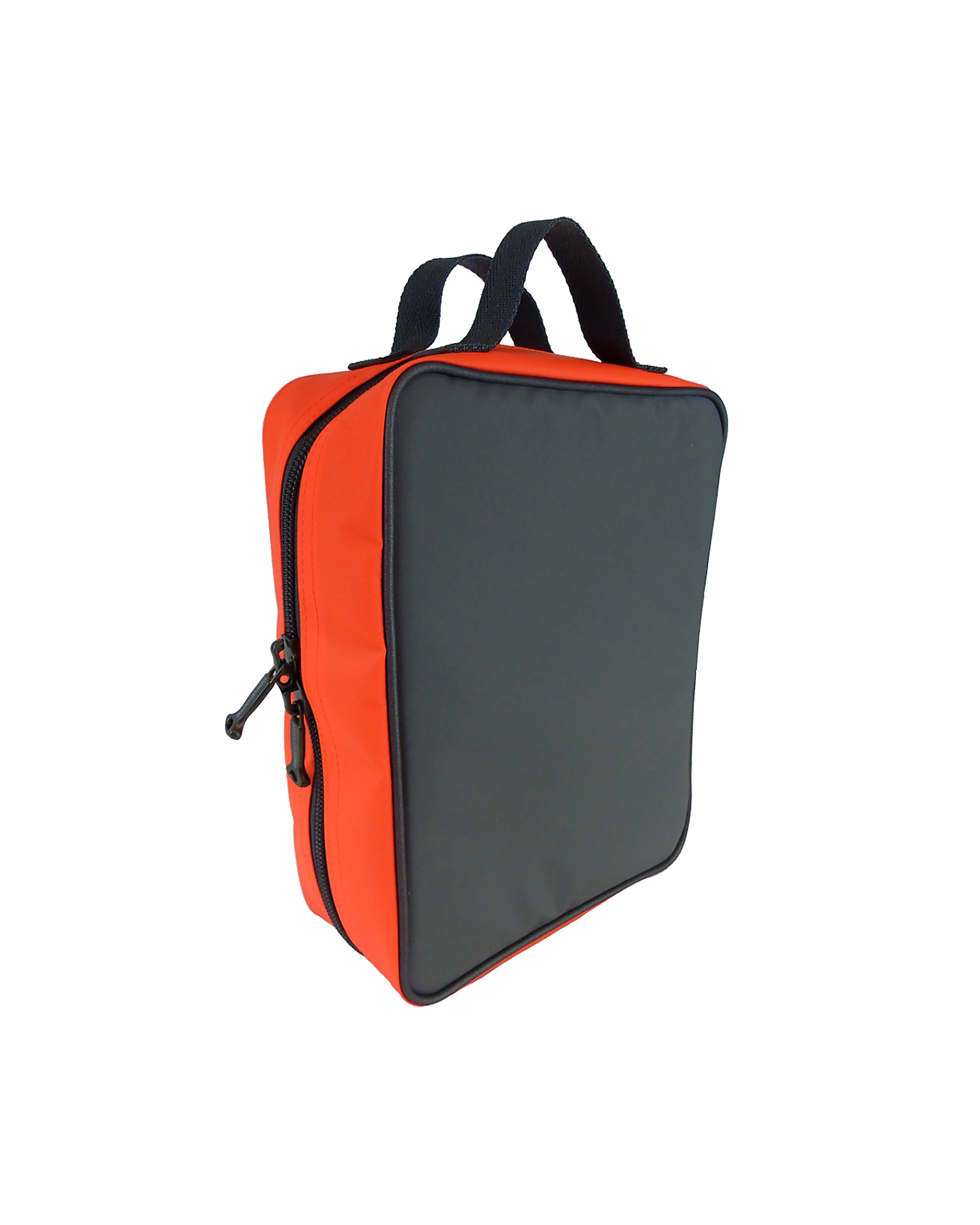
Photographs: Openhouse Products. View full image
- Dimensions
- 12 × 24 × 31 cm
- Carrying
- Grab handles.
- Physical features
- Stencilled working areas, equipment-retaining loops and lift-up equipment panels.
- Identification
- RFID pouch and barcode pocket. RFID tag not included. How rfid-nfc can support equipment checks
Dimensions as listed by Openhouse Products. View current specification
- Basic airway equipment on opening panelsOpening the bag presents two panels holding oropharyngeal airways and supraglottic airway devices. Nasogastric equipment and its enteral syringe remain accessible alongside them.
- Size-specific intubation layouts underneathLifting both panels reveals separate working areas for larger and smaller children. Stencilled equipment outlines guide stocking, preparation and checking. Endotracheal tubes are stored separately so the clinician can select the correct size for the individual child.
- Checklists and cognitive aidsAn information board provides a checklist, wipe-clean writing surface and space for a clinical support tool such as Age per Page clinical support handbook. This keeps airway checklists and supporting information visible during preparation, with somewhere to record drug doses. The handbook is not included with the bag.
Size coverage: configured for the service’s intended patient range, taking account of all airway equipment the team carries.
Photographs, films and kit lists show example configurations. Equipment shown is not necessarily included. Agree the stocked size range locally and confirm the current specification with the supplier.
The design
Three decisions behind the layout.
Pre-prepared. Standardised. Reproducible.
SCRAM™ provides a pre-prepared kit dump, ready to open at a moment’s notice. The stencilled layout guides stocking, checking and replenishment, moving the work of organising equipment into the time between emergencies.
A broad size range, clearly organised.
Paediatric preparation must accommodate equipment from neonates to adolescents. Separate working areas for larger and smaller children organise that range, while the clinician selects the equipment appropriate to the individual patient.
A brain-friendly layout.
Visual prompts show where equipment belongs. Space for checklists and paediatric references keeps equipment-sizing and drug-dose information close to hand, reducing reliance on memory during preparation.
Inside the design
The system has to do more of the work.
SCRAM™ was developed to improve preparation for emergency anaesthesia and tracheal intubation by designing around the people doing the work.
Even experienced clinicians have limited time and attention. Searching for equipment, remembering what is needed and assembling a working layout all add to the demands of caring for the patient.
SCRAM™ introduces an ergonomic change to that process. A pre-prepared, structured kit dump moves much of the organisational work ahead of the emergency. Equipment positions provide visual prompts, make omissions easier to notice and give the team a common reference for preparation and checking.
This is human-centred design in practice: understanding the demands on clinicians and shaping the equipment around how they see, think and work together.
Read the evidence behind the designCleaning and equipment records
- Cleaning between uses
-
Wipe-clean material supports cleaning between uses. Follow the manufacturer’s cleaning instructions and the service’s infection-control procedures before returning the bag to use.
SCRAM™ cleaning information - Link each bag to its checking record
-
Both bags provide for RFID and barcode identification. With a suitable tag or barcode and a compatible system, staff can open the individual bag’s stock list, view previous checks and record the next one. This connects the physical bag to its checking history.
RFID tags are not included.
Explore RFID and NFC options
The paediatric research
Testing the design.
The research examined whether changing how equipment is organised could reduce the time, errors and mental effort involved in preparing for a paediatric emergency.
Paediatric airway preparation
In a simulation study at a paediatric major trauma centre, 12 clinicians prepared equipment for a paediatric emergency using both Paediatric SCRAM™ and a standard resuscitation trolley. Participants had no prior experience of SCRAM™ or training in its use. Each participant used both systems. The conference abstract reported:
- Preparation time
- 11.5%shorter on average
- Preparation errors
- 20%fewer observed
- Self-reported cognitive load
- 9.8%lower on average
Results apply to Paediatric SCRAM™ equipment preparation in simulation. Read the study abstract
Watch the research presentation
Study methods and limitations
The participants were anaesthetic registrars, operating department practitioners and paediatric emergency nurses. They were randomly allocated to use one system first, then used the other at least two weeks later. This was their first exposure to SCRAM™, without prior training in its use.
The abstract reports an average preparation-time saving of 44.5 seconds, with a 95% confidence interval of 8.9–80.1 seconds. It does not report confidence intervals or significance tests for the differences in errors or self-reported cognitive load. The study did not assess the effect of further training or familiarity.
Bringing equipment and training together
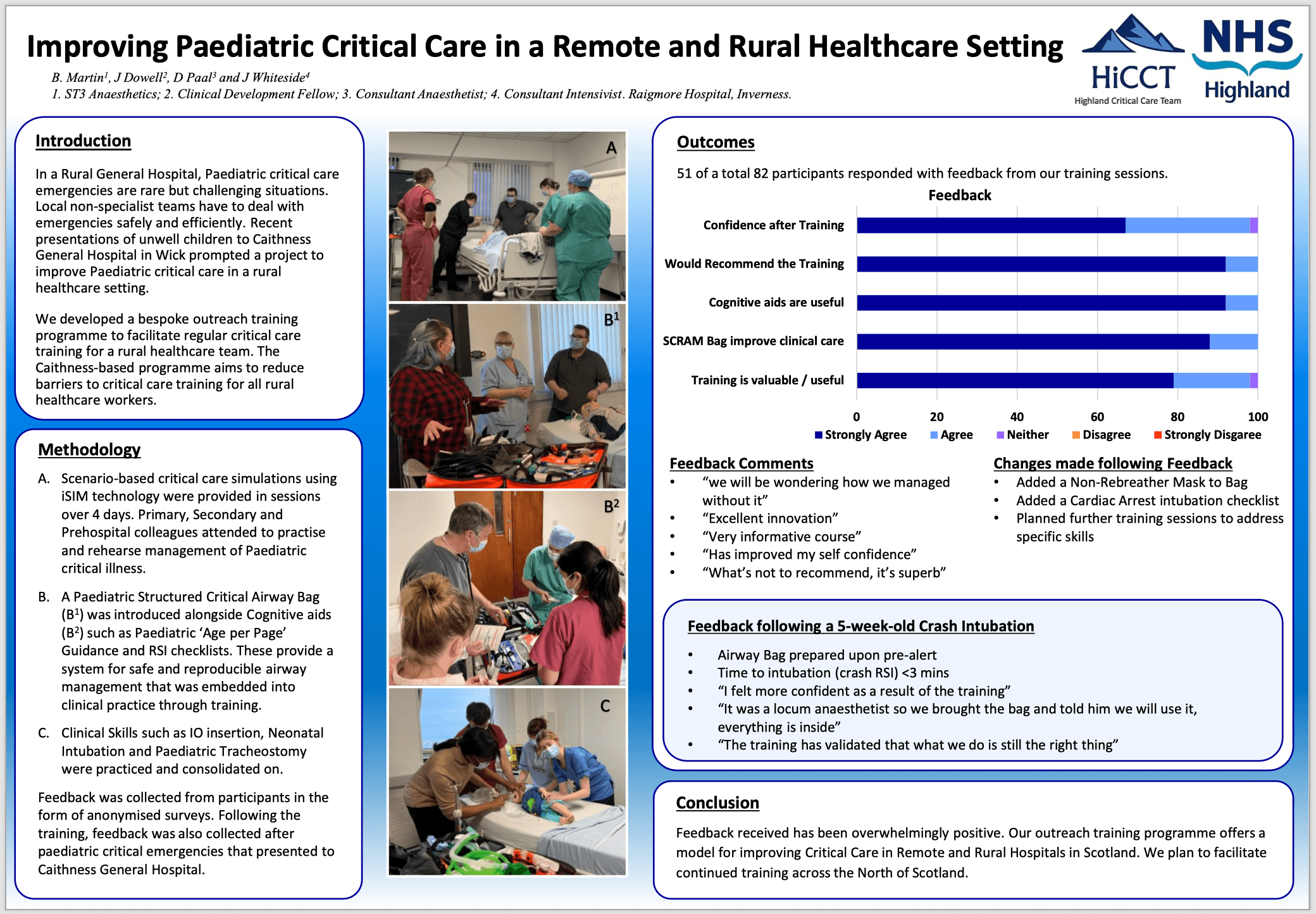
NHS Highland combined Paediatric SCRAM™ with locally developed checklists, action cards and training in rural hospitals. Teams practised in the settings where they would need to respond. This connects the equipment layout with the people and working environment it is intended to support.
Reported improvements in confidence and preparedness relate to the whole programme. View the programme poster
Wider research and references
Two adult simulation studies informed the wider SCRAM™ approach. The 2018 study tested pre-prepared drugs and equipment together; the 2020 study examined equipment preparation. They provide context for the design principles, but do not establish the effectiveness of either paediatric bag.
- Wylie M, Waters E, McCormack J, Swinton P. The SCRAM™ bag: a comparison between current practice versus a novel standardized approach for in-hospital pediatric emergency airway management. Critical Care. 2021;25(Suppl 1):P140. Conference abstract. Accompanying presentation ↗
- Martin B, Dowell J, Paal D, Whiteside J. Improving Paediatric Critical Care in a Remote and Rural Healthcare Setting. NHS Highland programme poster.
- Swinton P and colleagues. Impact of drug and equipment preparation on pre-hospital emergency Anaesthesia (PHEA) procedural time, error rate and cognitive load. Scandinavian Journal of Trauma, Resuscitation and Emergency Medicine. 2018;26:82.
- Schyma BM, Wood AE, Sothisrihari S, Swinton P. Optimising remote site airway management kit dump using the SCRAM™ bag—a randomised controlled trial. Perioperative Medicine. 2020;9:11.
Orders and enquiries
Where to order.
Choose the bag that suits your setting and existing equipment. Both bags can be ordered individually. Openhouse also lists an optional Paediatric SCRAM™ and PaedEMS SCRAM™ bundle for services that need both formats.

Openhouse Products
Product specifications, configuration and global orders.
Order Paediatric SCRAM™ ↗Order PaedEMS SCRAM™ ↗
The Resus Tailor
A US ordering route for both products.
Order Paediatric SCRAM™ ↗Order PaedEMS SCRAM™ ↗The Paediatric SCRAM™ line was co-invented and designed by Paul Swinton, Dr Jon McCormack and Neil Sinclair. Openhouse Products manufactures and distributes the products, with The Resus Tailor providing a US ordering route.
Disclosure: Paul Swinton co-invented the Peadiatric SCRAM™ line with Dr Jon McCormack and Neil Sinclair and have a commercial interest in the SCRAM™ system. Roles are as stated above — Openhouse Products manufactures and distributes; The Resus Tailor is a distributor.
The wider SCRAM™ story. Read about the preparation problem, design principles and research behind the original system.
Read the SCRAM™ story →Explore the SCRAM™ range
Explore the SCRAM™ range.
Equipment, medication and procedural preparation for different clinical settings.